German lessons · Everyday German phrases · B1
Genau! Ich sehe das anders: agreeing and disagreeing in German
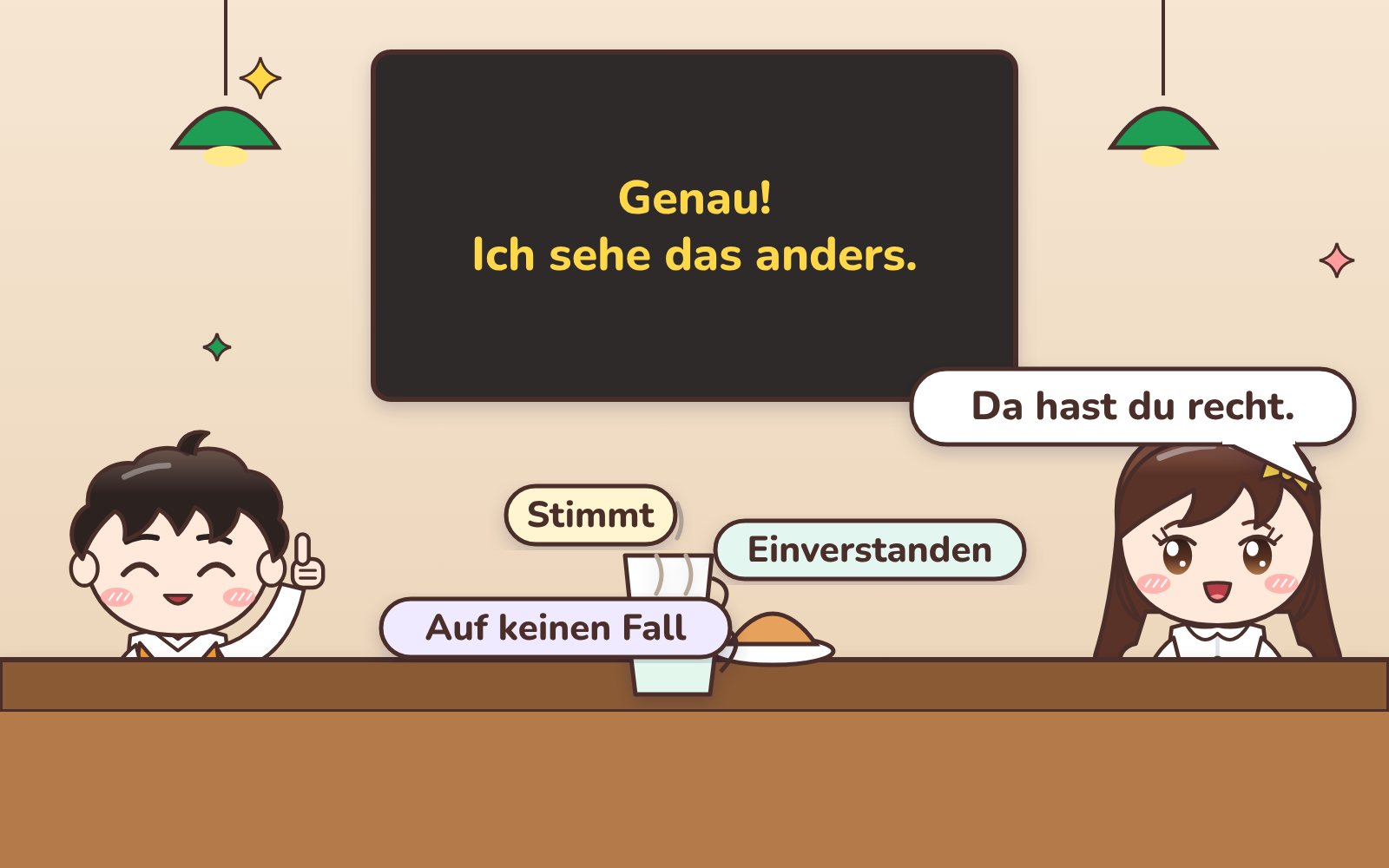
Spend some time in Germany and you'll notice that people say quite openly when they disagree. In meetings and around the dinner table alike, "I see that differently" comes up quite naturally. It isn't rude: many Germans simply feel that a real conversation means sharing opinions. So if you know both how to agree and how to disagree politely, it's much easier to join in. These phrases are also very useful in the speaking parts of exams.
That's right! Agreeing
- Genau. — Exactly. That's it. The most common way to agree. You can also drop it in briefly while the other person is talking
- Stimmt. — That's right. Use it to confirm that something is true. You can also say Das stimmt.
- Da hast du recht. / Da haben Sie recht. — You're right there. du with friends, Sie with people you don't know or at work
- Das sehe ich auch so. — I see it that way too.
- Ich bin ganz deiner Meinung. / Ich bin ganz Ihrer Meinung. — I completely agree with you.
- Auf jeden Fall! — Definitely! Absolutely! For strong agreement
- Einverstanden. — Fine, agreed. Use it to say yes to a suggestion or a plan
Hmm… half agreeing
- Ja, schon, aber … — Yes, sure, but … Admit the point first, then say what's different
- Da ist was dran. — There's something in that. Common in relaxed conversations
- Das kommt darauf an. — It depends. You can carry straight on with Das kommt darauf an, ob …
- Einerseits …, andererseits … — On the one hand …, on the other hand …
I see it differently: disagreeing
When you disagree, giving a reason is the German way of being polite.
- Ich sehe das anders. — I see that differently. The safest way to disagree
- Das stimmt nicht ganz. — That's not quite right. Use it to correct part of a fact
- Da bin ich anderer Meinung. — I have a different opinion on that.
- Ich bin mir da nicht so sicher. — I'm not so sure about that. A very gentle way to disagree
- Das finde ich nicht. — I don't think so. Common among friends
- Auf keinen Fall! — No way! Strong disagreement, so only use it when you're really sure
Short dialogue
A: Ich finde, wir sollten am Wochenende mit dem Auto an die Ostsee fahren. — I think we should drive to the Baltic coast at the weekend. B: Ja, schon, aber mit dem Zug ist es viel entspannter. — Yes, sure, but it's much more relaxing by train. A: Das stimmt nicht ganz. Am Wochenende sind die Züge oft voll. — That's not quite right. The trains are often full at weekends. B: Da hast du recht. Aber wir könnten früh losfahren. — You're right there. But we could leave early. A: Hm, da ist was dran. Und wir müssen keinen Parkplatz suchen. — Hmm, there's something in that. And we don't have to look for a parking space. B: Genau! Also nehmen wir den Zug? — Exactly! So shall we take the train? A: Einverstanden. — Agreed.
Watch out
- Du hast recht is usually written with a small recht (capital Recht haben is also allowed by the spelling rules). You don't say richtig haben
- Ich bin einverstanden. means "I agree", not "I understand". To say you've understood, use Ich verstehe.
- Coming straight out with Auf keinen Fall! or Das ist falsch! at work sounds quite harsh. Try starting gently, with something like Ich bin mir da nicht so sicher, weil …
- When you say Ich bin nicht einverstanden, adding a reason makes it sound much more natural
Quick check
- You want to disagree gently with your boss. Which is best? (a) Auf keinen Fall! (b) Ich bin mir da nicht so sicher. (c) Das finde ich nicht.
Answer
(b) Ich bin mir da nicht so sicher. It's the gentlest way to disagree. It's good to add a reason afterwards.- A friend suggests a plan and you want to say yes. How do you say it in one word?
Answer
Einverstanden. (or Genau!, Auf jeden Fall!)- How do you say "It depends" in German?