German lessons · Everyday German phrases · A2
Ich hätte gern zwei Brötchen: German for the bakery and the market
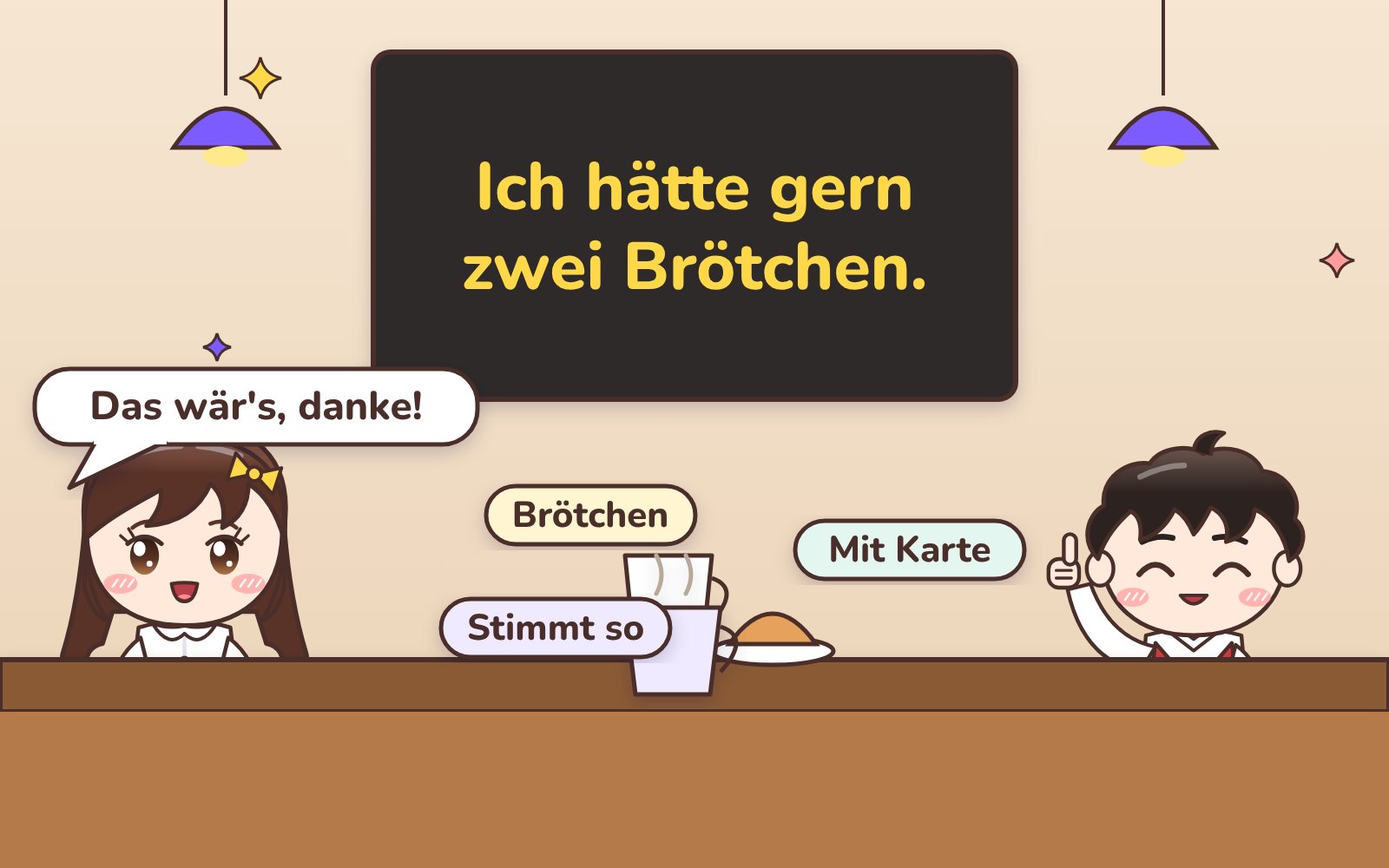
You could say the German day starts at the bakery (die Bäckerei) — there's one on almost every corner. But at most of them you don't pick up the bread yourself: you order out loud from the staff at the counter. With a long queue and a fast-talking assistant it can feel stressful at first, but the sentences hardly ever change. Learn the few below and you can use them just the same at the weekly market (der Wochenmarkt).
When it's your turn
- Wer ist der Nächste? / Wer ist dran? — Who's next? / Whose turn is it? When the assistant asks this, raise your hand a little and answer.
- Ich bin dran. — It's my turn. Useful when the queue isn't clear. If someone else was there first, let them go ahead with Sie waren zuerst. (You were first.)
- Was darf es sein? / Was hätten Sie gern? — What can I get you? What the assistant says when taking your order.
Ordering
- Ich hätte gern zwei Brötchen. — I'd like two bread rolls, please. The most polite and natural way to order. Ich möchte … works well too.
- Ich nehme ein Roggenbrot. — I'll take a rye bread. A relaxed way to say what you've chosen.
- Einmal das hier, bitte. — One of these, please. Point at it when you don't know the name. Zweimal means two.
- Können Sie es bitte schneiden? — Could you slice it, please? Large loaves are sliced by machine. The assistant may ask you first: Geschnitten? (Sliced?)
- Ich hätte gern 200 Gramm Bergkäse. — I'd like 200 grams of mountain cheese, please. At the market or the cheese and meat counter, you order by weight. Ein halbes Kilo (half a kilo) is common too.
- Was kostet ein Kilo Äpfel? — How much is a kilo of apples?
Finishing and paying
- Sonst noch etwas? — Nein, danke. Das wär's. — Anything else? — No, thanks. That's everything. Das wär's is short for Das wäre es, the standard way to end your order.
- Zum Mitnehmen oder zum Hieressen? — To take away or to eat in? You'll often hear this when you order coffee or a sandwich. Answer Zum Mitnehmen, bitte.
- Kann ich mit Karte zahlen? — Mit Karte, bitte. — Can I pay by card? — By card, please. Some small bakeries and market stalls still take cash only, so it's worth asking first.
- Stimmt so. — Keep the change. Use it when you want to leave the change as a tip.
Short dialogue
A: Guten Morgen! Wer ist der Nächste? — Good morning! Who's next? B: Ich. Ich hätte gern vier Brötchen und ein Mischbrot. — Me. I'd like four rolls and a mixed rye-wheat loaf, please. A: Soll ich das Brot schneiden? — Shall I slice the bread? B: Ja, bitte. — Yes, please. A: Sonst noch etwas? — Anything else? B: Nein, danke, das wär's. Kann ich mit Karte zahlen? — No, thanks, that's everything. Can I pay by card? A: Ja, klar. Das macht 6,80 Euro. — Yes, of course. That's 6.80 euros. B: Danke, schönen Tag noch! — Thanks, have a nice day!
Watch out
- Avoid Ich will … — it sounds like "I want", which is too blunt when ordering. Ich hätte gern … or Ich möchte … are better. That said, Ich bekomme zwei Brötchen. (literally "I'm getting two rolls") is a very common way to order in Germany — and it doesn't mean "become"!
- Bread roll names change by region — a small roll is a Brötchen in the north, a Semmel in Bavaria and Austria, a Schrippe in Berlin, and sometimes a Weck or Weckle in the south-west.
- Many bakeries open on Sundays — when most shops are closed, lots of bakeries still open for a few hours in the morning, but the times vary from shop to shop.
Quick check
- The assistant asks "Sonst noch etwas?". How do you finish your order?
Answer
Nein, danke. Das wär's. — No, thanks. That's everything.- You don't know the name of a pastry. How do you point and say "One of these, please"?
Answer
Einmal das hier, bitte.- What do you say when you want to leave the change as a tip?