German lessons · Everyday German phrases · A2
Sehr geehrte Damen und Herren: formal German emails from the first line to the sign-off
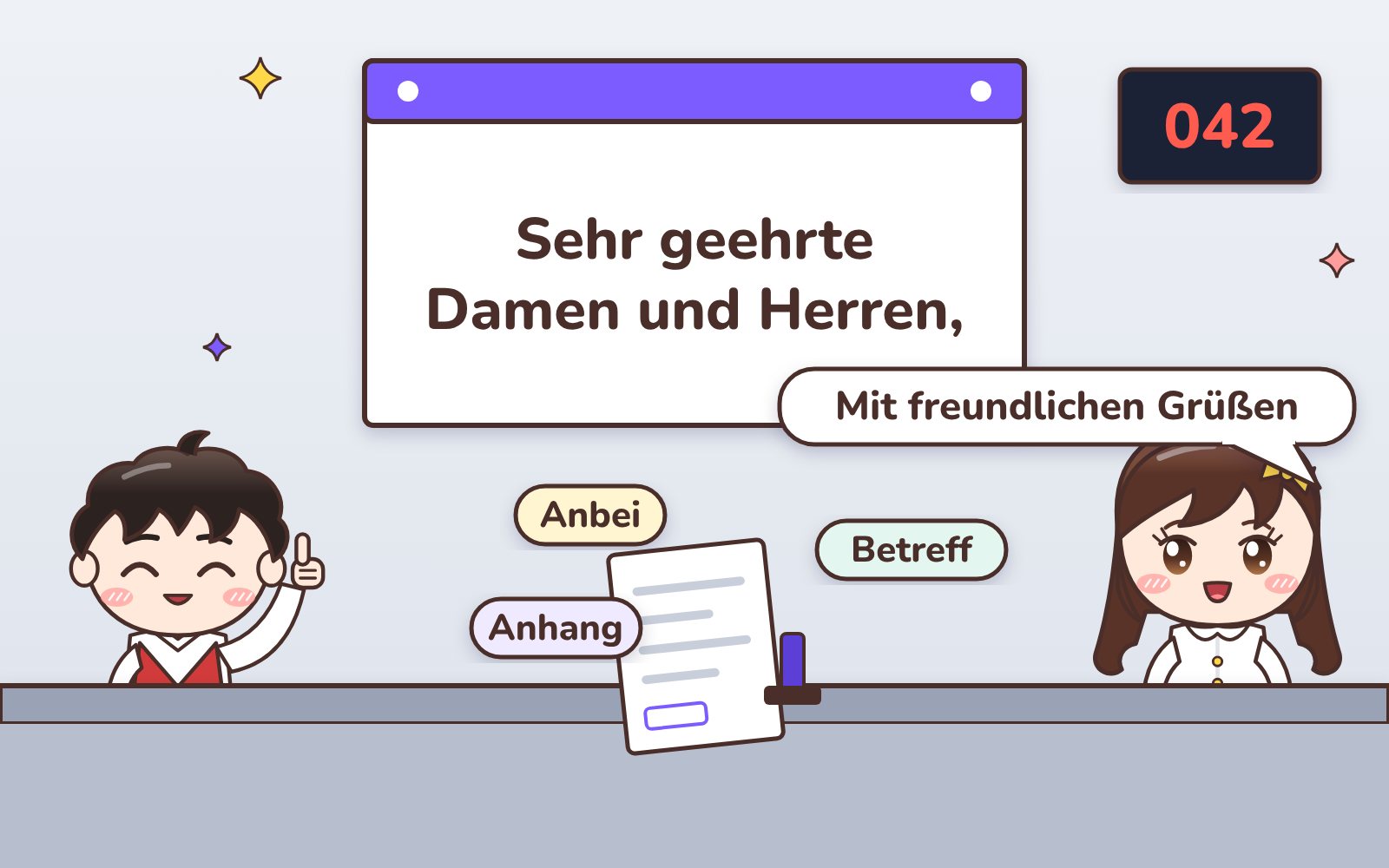
A lot of things in Germany are still sorted out by email and letter: reporting a fault to your landlord, sending documents to an office, asking your insurance a question. Unlike a message to a friend, these follow a fixed pattern. Just getting the greeting in the first line and the sign-off at the end right makes you look far more reliable. And formal German emails like to be short and clear: rather than a long friendly opening, they get straight to the point.
Addressing the reader (Anrede)
- Sehr geehrte Damen und Herren, — Dear Sir or Madam, The standard greeting when you don't know the recipient's name. Use it when you first write to an office or a company.
- Sehr geehrte Frau Schulz, / Sehr geehrter Herr Wagner, — Dear Ms Schulz, / Dear Mr Wagner, If you know the name, always use it. The ending changes: geehrte for a woman, geehrter for a man.
- Guten Tag Frau Schulz, — Hello Ms Schulz, A little less stiff. Very common once you've exchanged a few emails.
- Liebe Frau Schulz, / Lieber Herr Wagner, — Dear Ms Schulz, / Dear Mr Wagner, Warm, but still for people you call Sie. In a first formal email it can seem too familiar.
Put a comma after the greeting and start the text on the next line with a lower-case letter: Sehr geehrte Damen und Herren, ich schreibe Ihnen, weil … (unlike in English, where you'd start with a capital).
Saying why you're writing
- ich schreibe Ihnen, weil meine Heizung nicht funktioniert. — I'm writing to you because my heating isn't working. The easiest first sentence: give the reason straight away.
- ich möchte mich nach dem Stand meines Antrags erkundigen. — I would like to ask about the status of my application. For checking on progress with an office or your insurance.
- vielen Dank für Ihre E-Mail. — Thank you for your email. A good first sentence when you reply.
Attachments and requests
- Anbei sende ich Ihnen die Kopie meines Mietvertrags. — Please find attached a copy of my tenancy agreement. Anbei (enclosed, attached) comes up all the time in formal emails.
- Im Anhang finden Sie meine Unterlagen. — You'll find my documents attached. Der Anhang is "the attachment".
- Könnten Sie mir bitte mitteilen, wann der Techniker kommt? — Could you please let me know when the technician is coming? Könnten Sie …? is the basic polite way to ask for something.
- Ich bitte Sie um eine kurze Rückmeldung. — I would be grateful for a short reply. Use it near the end when you want an answer.
Closing and signing off (Grußformel)
- Für Rückfragen stehe ich Ihnen gern zur Verfügung. — Please don't hesitate to contact me if you have any questions. A common closing line in work emails and applications.
- Mit freundlichen Grüßen — Kind regards / Yours sincerely (formal sign-off) The standard choice. No comma after it; your name goes on the next line.
- Viele Grüße / Beste Grüße — Best wishes A bit lighter. Fine for a contact you already know.
Short example email
Betreff: Defekte Heizung in der Wohnung 3. OG links — Subject: Broken heating in the flat on the 3rd floor, left
Sehr geehrter Herr Wagner, — Dear Mr Wagner,
ich schreibe Ihnen, weil die Heizung in meinem Wohnzimmer seit Montag nicht funktioniert. — I'm writing to you because the heating in my living room hasn't been working since Monday.
Anbei sende ich Ihnen ein Foto vom Heizkörper. — I'm attaching a photo of the radiator.
Könnten Sie mir bitte mitteilen, wann ein Techniker kommen kann? — Could you please let me know when a technician can come?
Mit freundlichen Grüßen — Kind regards
Alex Smith
Watch out
- geehrte / geehrter — writing Sehr geehrter Frau … to a woman is a very common mistake. It's geehrte for a woman and geehrter for a man.
- Sie, Ihnen, Ihr with a capital letter — in a formal email, Sie meaning "you" is always capitalised. Lower-case ihnen means "to them", which is something else entirely.
- Avoid Hallo in formal emails — it's fine for friends and colleagues, but to an office or a company you're contacting for the first time, Hallo sounds too casual.
- Don't abbreviate to MfG — shortening Mit freundlichen Grüßen to MfG looks careless.
Quick check
- You're writing to someone at an office and don't know their name. What's your first line?
Answer
Sehr geehrte Damen und Herren, — the standard greeting when you don't know the name.- „Sehr geehrte___ Herr Becker," — which ending goes in the gap?
Answer
-r → Sehr geehrter Herr Becker, — before a man's name it's geehrter.- Which one word tells the reader you've attached documents?