German lessons · Everyday German phrases · A2
Entschuldigung, Tut mir leid, Danke: saying sorry and thank you in German
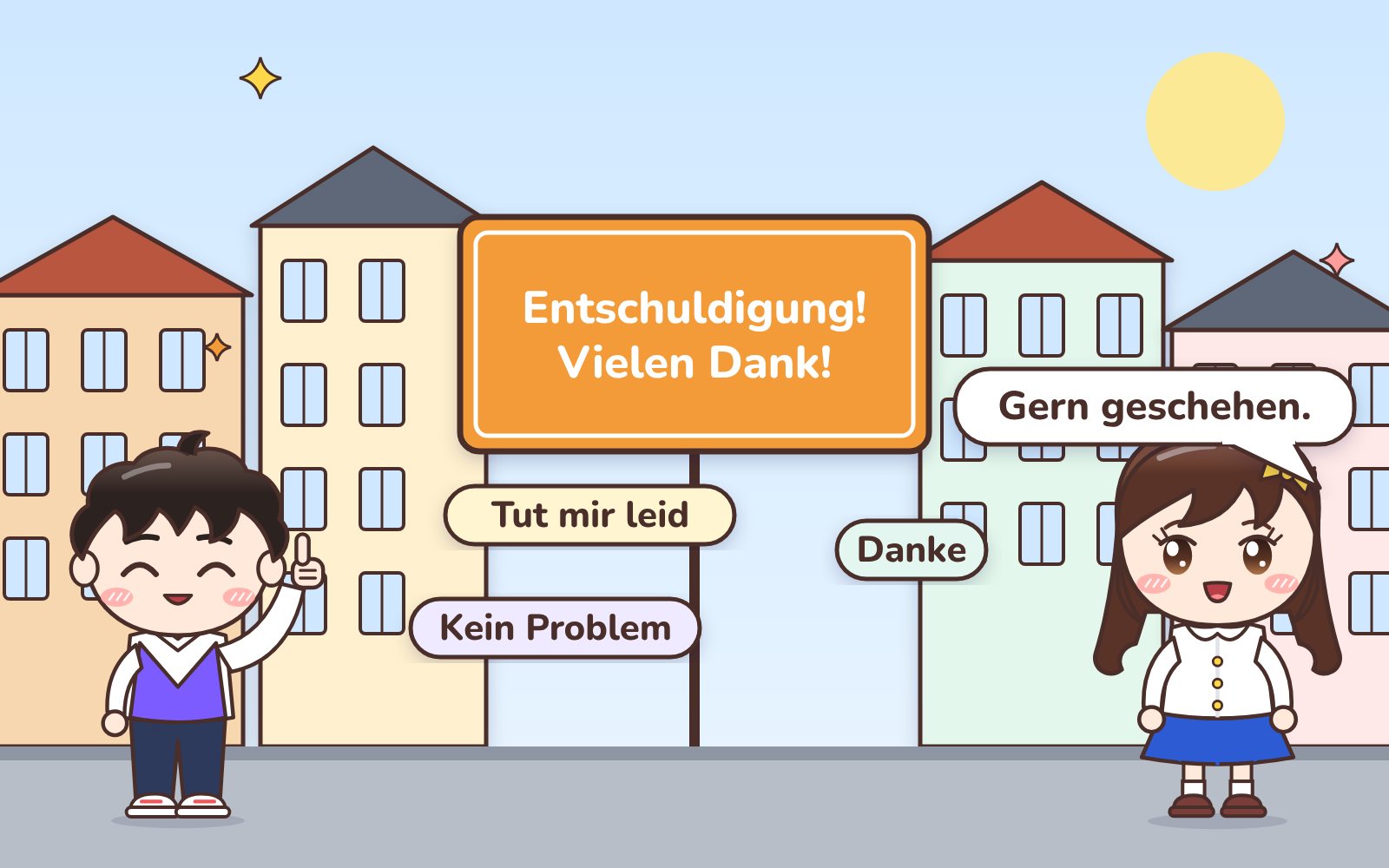
You'll say "sorry" and "thank you" in German several times a day: getting off the U-Bahn, at the bakery, when a neighbour has taken in a parcel for you. But there's more than one way to apologise, which can be confusing at first. Entschuldigung is the light one, like "excuse me" or "sorry", while Tut mir leid ("I'm sorry", literally "it pains me") is for when you really mean it. Learn the replies to "thank you" as well and your conversations will flow much more naturally.
Light: excuse me, sorry
- Entschuldigung! — Excuse me! / Sorry! Use it to ask the way, when you bump into someone lightly, or to get a shop assistant's attention.
- Entschuldigen Sie, … — Excuse me, … (polite, with Sie) Entschuldigen Sie, wo ist der Bahnhof? — Excuse me, where's the station?
- Sorry! — Sorry! Very common among young people and friends, but only for small slip-ups.
- Darf ich mal vorbei? — Can I just get past? Use it on a crowded bus or in a supermarket aisle. Just pushing past is rude.
Sincere: I'm really sorry
- Tut mir leid. — I'm sorry. Use it when something is your fault, or when something bad has happened to the other person.
- Das tut mir wirklich leid. — I'm really sorry. / That's really awful.
- Entschuldigung, dass ich zu spät komme. — Sorry I'm late.
- Ich möchte mich entschuldigen. — I'd like to apologise. For work or formal situations.
Thank you, and what to say back
- Danke! / Danke schön! — Thank you! The basic one.
- Vielen Dank! / Vielen Dank für Ihre Hilfe. — Thank you very much. / Thank you very much for your help.
- Gern geschehen. / Gerne! — You're welcome. You'll hear this a lot in shops and services.
- Bitte! / Bitte schön! — You're welcome. The most common answer to Danke.
- Kein Problem. / Keine Ursache. — No problem. / Don't mention it. Casual and everyday.
- Nichts zu danken. — No need to thank me.
Short dialogue
A: Entschuldigung, ist der Platz noch frei? — Excuse me, is this seat free? B: Ja, bitte. — Yes, go ahead. A: Danke schön! Oh, Entschuldigung, ich bin Ihnen auf den Fuß getreten! — Thank you! Oh, sorry, I stepped on your foot! B: Kein Problem. — No problem. A: Tut mir wirklich leid. — I'm really sorry. B: Alles gut, nichts passiert. — It's fine, no harm done.
Watch out
- Tut mir leid isn't only an apology — it's also used for sympathy, just like "I'm sorry" in English. Mein Opa ist krank. — Oh, das tut mir leid. (My grandad is ill. — Oh, I'm sorry to hear that.) You can say it even when nothing is your fault.
- Don't answer Entschuldigung with Bitte. Kein Problem, Macht nichts (never mind) or Alles gut (it's fine) sound natural.
- Bitte has lots of meanings: "please", "here you are", "you're welcome" and "pardon?". Said with a rising tone, Bitte? means "Sorry, what did you say?"
Quick check
- You want to get off the U-Bahn, but someone is standing in front of the door. What do you say?
Answer
Entschuldigung, darf ich mal vorbei? — Excuse me, can I just get past?- A colleague says "Mein Hund ist gestorben." What's the right thing to say? (Entschuldigung / Das tut mir leid)
Answer
Das tut mir leid. — to show sympathy, use Tut mir leid.- Someone says "Vielen Dank für Ihre Hilfe!" Give one polite answer.