German lessons · German grammar · A2
The Dative Case
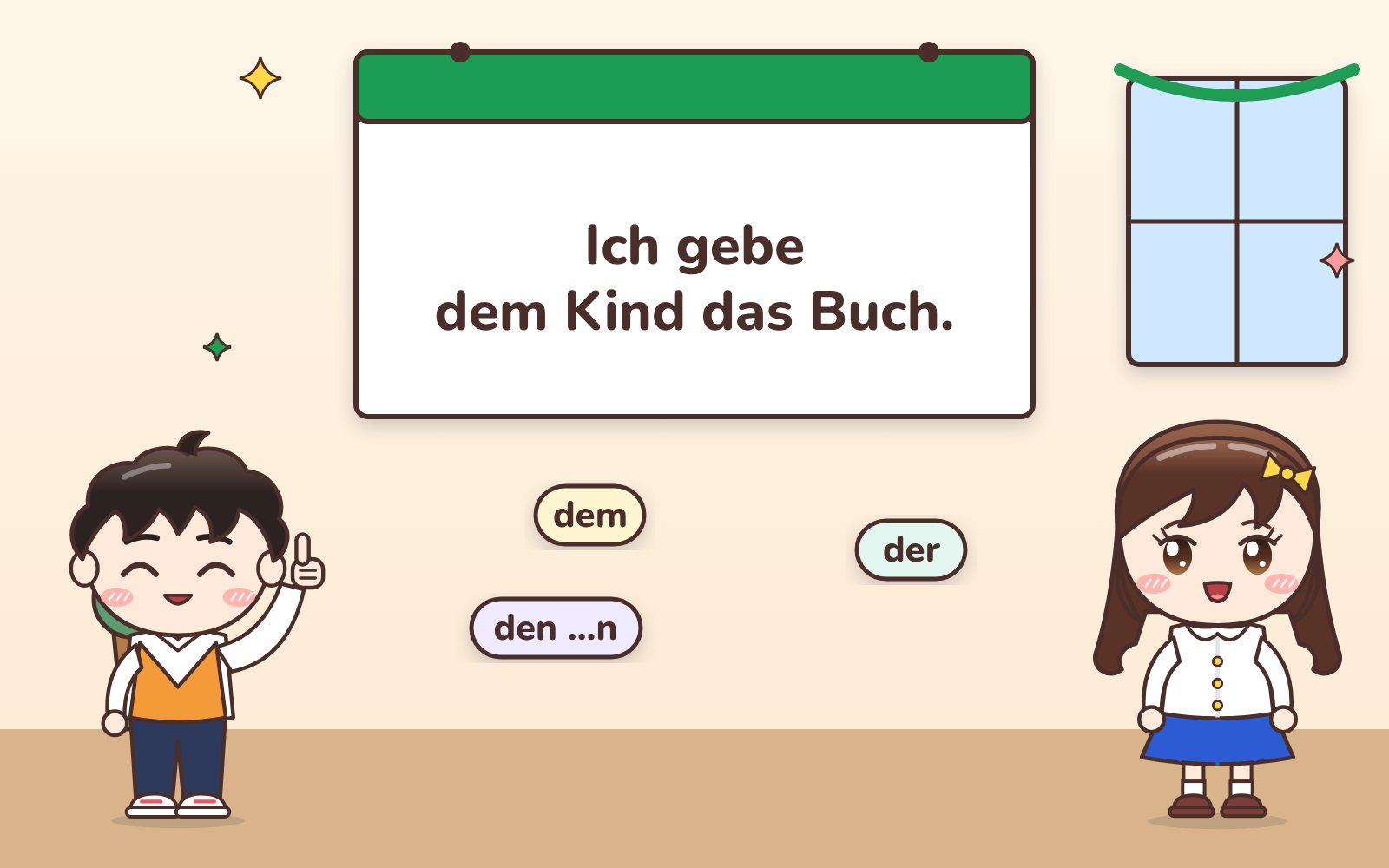
The dative answers the question Wem? — "to whom?" or "for whom?". You need it every day: when you give someone something, after very common prepositions like mit and zu, and with a handful of everyday verbs. Learners stumble because the articles change again (der suddenly becomes dem, die becomes der), and because some verbs that look like they need a direct object actually take the dative.
Who receives something? The indirect object
With verbs like geben (give), schenken (give as a present), zeigen (show), erklären (explain) or bringen (bring), the thing is in the accusative and the person who receives it is in the dative. When both are nouns, the dative usually comes first.
| masculine | feminine | neuter | plural | |
|---|---|---|---|---|
| definite | dem Mann | der Frau | dem Kind | den Kindern |
| indefinite | einem Mann | einer Frau | einem Kind | — |
| possessive | meinem Mann | meiner Frau | meinem Kind | meinen Kindern |
In the plural, the noun itself gets an extra -n (den Kindern, den Freunden), unless it already ends in -n or -s (den Frauen, den Autos).
- Ich gebe dem Mann das Buch. — I give the man the book.
- Sie schenkt ihrer Mutter Blumen. — She gives her mother flowers.
- Wir zeigen den Kindern den Zoo. — We show the children the zoo.
- Der Lehrer erklärt einem Schüler die Aufgabe. — The teacher explains the task to a student.
Personal pronouns in the dative
| nominative | ich | du | er | sie | es | wir | ihr | sie | Sie |
|---|---|---|---|---|---|---|---|---|---|
| dative | mir | dir | ihm | ihr | ihm | uns | euch | ihnen | Ihnen |
Careful: ihr can be "you all" (nominative) or "to her" (dative) — the context tells you which. If the accusative thing is also a pronoun, it comes first: Ich gebe es ihm.
- Ich gebe dir meine Nummer. — I'll give you my number.
- Kannst du mir das Foto zeigen? — Can you show me the photo?
- Wir schenken ihr ein Buch. — We're giving her a book.
- Ich schreibe Ihnen eine E-Mail. — I'll write you an email.
- Ich gebe es ihm. — I give it to him.
Prepositions that always take the dative
These seven prepositions are always followed by the dative — no exceptions. Many learners memorise them as one chunk: aus, bei, mit, nach, seit, von, zu.
| preposition | meaning | example |
|---|---|---|
| aus | from (origin), out of | aus der Schweiz |
| bei | at (someone's place), near | bei meinen Eltern |
| mit | with, by (transport) | mit dem Bus |
| nach | after; to (cities, countries) | nach dem Kurs, nach Berlin |
| seit | since, for (time) | seit einem Jahr |
| von | from, of | von meiner Freundin |
| zu | to (people, places) | zu meinem Bruder |
Short forms are normal in speech and writing: zu dem → zum, zu der → zur, bei dem → beim, von dem → vom.
- Ich fahre mit dem Bus zur Arbeit. — I go to work by bus.
- Nach dem Deutschkurs gehe ich zum Arzt. — After the German course I'm going to the doctor.
- Sie wohnt seit einem Jahr in Hamburg. — She has been living in Hamburg for a year.
- Mein Kollege kommt aus der Schweiz. — My colleague is from Switzerland.
- Ich bin heute Abend bei meinen Eltern. — I'm at my parents' place tonight.
- Das Geschenk ist vom Chef. — The present is from the boss.
Note that seit uses the present tense in German, where English says "has been living".
Verbs that take the dative
Some verbs have only one object, and it is in the dative. Learn these four first: helfen (help), danken (thank), gefallen (please, be liked), gehören (belong to). With gefallen, the thing you like is the subject, and the person who likes it is in the dative.
| verb | example |
|---|---|
| helfen | Ich helfe dir. |
| danken | Ich danke Ihnen. |
| gefallen | Das Bild gefällt mir. |
| gehören | Die Tasche gehört ihr. |
Other common ones: antworten, gratulieren, passen, schmecken.
- Kannst du mir bitte helfen? — Can you help me, please?
- Ich danke Ihnen für die Hilfe. — Thank you for your help.
- Die Wohnung gefällt meiner Frau. — My wife likes the apartment.
- Die Schuhe gefallen mir nicht. — I don't like the shoes.
- Wem gehört das Fahrrad? – Es gehört meinem Bruder. — Whose bike is this? – It belongs to my brother.
Common mistakes
- ✗ Ich helfe dich. → ✓ Ich helfe dir. (helfen always takes the dative)
- ✗ Ich fahre mit den Bus. → ✓ Ich fahre mit dem Bus. (mit + dative: der Bus → dem Bus)
- ✗ Ich gebe den Kinder Schokolade. → ✓ Ich gebe den Kindern Schokolade. (dative plural adds -n)
Quick check
- Ich fahre mit ___ U-Bahn. (die U-Bahn)
Answer
Ich fahre mit der U-Bahn. — feminine die becomes der in the dative.- Das Buch gehört ___. (ich)
Answer
Das Buch gehört mir.- Ich gehe ___ Bäckerei. (zu + die)