German lessons · German grammar · B1
warten auf, denken an: verbs with prepositions, plus darauf and worauf
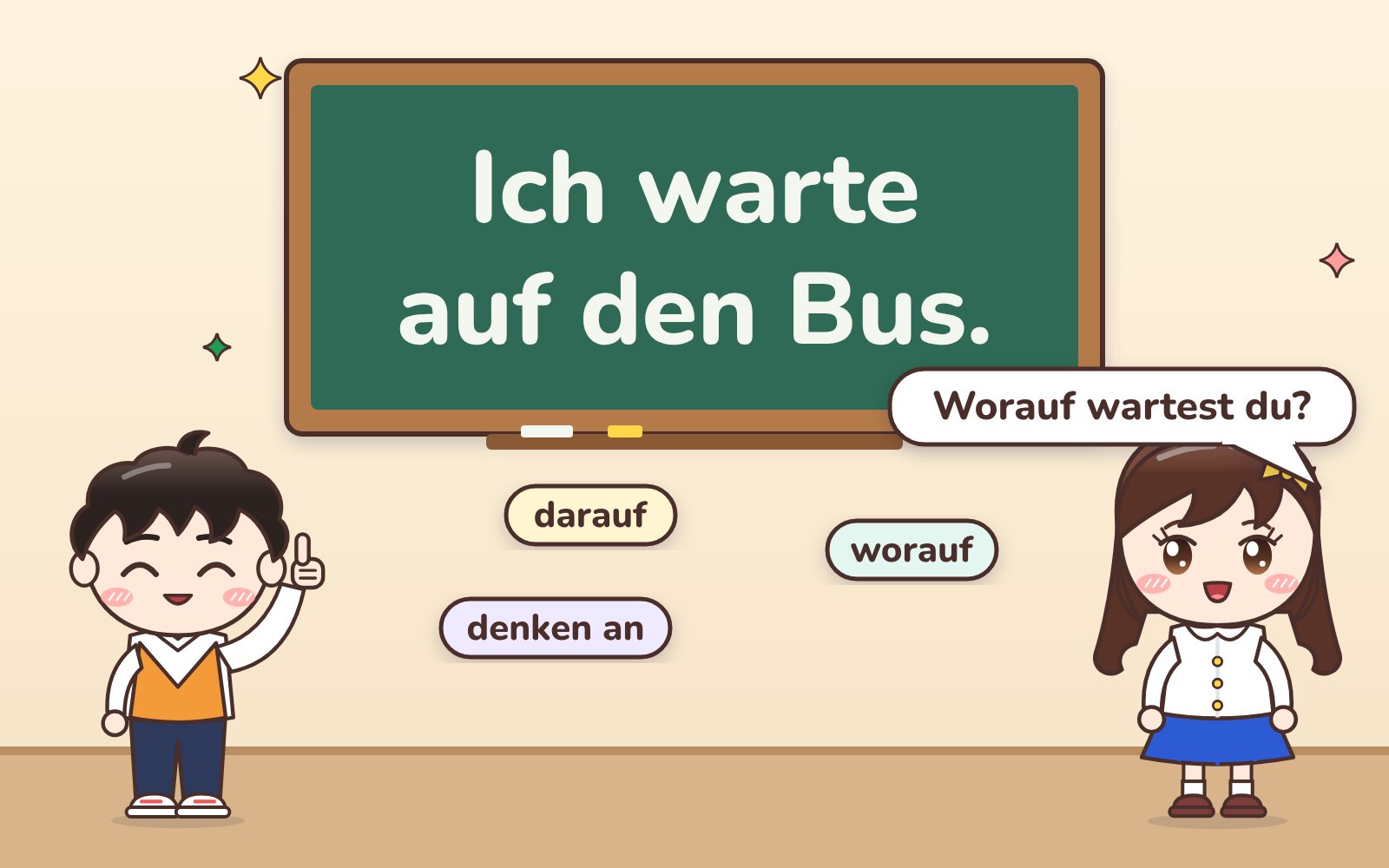
"I'm waiting for the bus" is Ich warte auf den Bus. in German. English also needs a preposition here (wait for), but German warten always goes with auf, not with für. Lots of verbs work like this, and the preposition often isn't the one English would use, so translating word for word doesn't help. The fastest way is to learn verb + preposition + case as one chunk.
The rule: learn verb + preposition + case as a set
Once the preposition is fixed, so is the case that follows. An and auf can take either the dative or the accusative, but when they're paired with a verb it's usually the accusative. Mit, von, zu, nach always take the dative; für, um, über always take the accusative.
| Verb | Preposition + case | Meaning |
|---|---|---|
| warten | auf + accusative | to wait for |
| denken | an + accusative | to think of, to remember |
| sich freuen | auf + accusative / über + accusative | to look forward to / to be pleased about |
| sich kümmern | um + accusative | to look after, to take care of |
| sich interessieren | für + accusative | to be interested in |
| sprechen | mit + dative / über + accusative | to talk to / to talk about |
| fragen | nach + dative | to ask about |
| teilnehmen | an + dative | to take part in |
- Ich warte auf den Bus. — I'm waiting for the bus.
- Denkst du an den Termin morgen? — You haven't forgotten the appointment tomorrow, have you?
- Wir freuen uns auf das Wochenende. — We're looking forward to the weekend.
- Ich freue mich über dein Geschenk. — I'm really pleased with your present.
- Meine Nachbarin kümmert sich um die Katze. — My neighbour looks after the cat.
- Er nimmt am Deutschkurs teil. — He's taking part in the German course. (am = an dem)
Notice sich freuen: auf is for something still to come, über for something that has already happened.
For things: da- + preposition (darauf, daran, darum)
When you refer back to a thing or idea you've already mentioned, you don't say auf es; you use da + preposition. If the preposition starts with a vowel, add an r: da + auf = darauf, da + an = daran, da + um = darum, da + über = darüber. If it starts with a consonant, just join them: dafür, damit, davon. It works a bit like old-fashioned English thereon or thereof.
- Wartest du auf das Paket? — Ja, ich warte darauf. — Are you waiting for the parcel? — Yes, I'm waiting for it.
- Interessierst du dich für Fußball? — Nein, dafür interessiere ich mich nicht. — Are you interested in football? — No, I'm not interested in it.
- Ich kümmere mich darum. — I'll take care of it.
For people, don't use da-; use the preposition + a pronoun.
- Wartest du auf Anna? — Ja, ich warte auf sie. — Are you waiting for Anna? — Yes, I'm waiting for her.
- Ich denke oft an meine Eltern. — Ich denke auch oft an sie. — I often think of my parents. — I often think of them too.
Questions: wo- + preposition (worauf, woran, wofür)
To ask about a thing, use wo + preposition. Again, add an r before a vowel: worauf, woran, worüber, worum. Before a consonant: wofür, womit, wovon. To ask about a person, use preposition + wen/wem.
| About what? (things) | About whom? (people) |
|---|---|
| Worauf wartest du? | Auf wen wartest du? |
| Woran denkst du? | An wen denkst du? |
| Wofür interessierst du dich? | Für wen …? |
| Womit schreibst du? | Mit wem sprichst du? |
- Worauf freust du dich am meisten? — What are you looking forward to most?
- Mit wem hast du gesprochen? — Who did you talk to?
- Worüber sprecht ihr? — What are you talking about?
A da- compound can also point ahead to a whole clause that follows: Ich freue mich darauf, dich zu sehen. (I'm looking forward to seeing you.) Denk bitte daran, dass morgen Feiertag ist. (Please remember that tomorrow is a public holiday.)
Common mistakes
- ✗ Ich warte den Bus. → ✓ Ich warte auf den Bus. (warten always takes auf)
- ✗ Ich warte auf es. → ✓ Ich warte darauf. (for things, use a da- compound)
- ✗ Für was interessierst du dich? → ✓ Wofür interessierst du dich? (you'll hear für was in casual speech, but in exams and writing use wofür)
Quick check
- Ich freue mich ___ die Ferien. (I'm looking forward to the holidays)
Answer
auf — for something still to come, it's sich freuen auf + accusative.- „Denkst du an die Rechnung?" — „Ja, ich denke ___." (refer back to it)
Answer
daran — it's a thing (die Rechnung), so da + r + an.- ___ sprichst du? — Mit meiner Chefin. (with whom?)