German lessons · German grammar · B1
den Studenten, dem Kunden: masculine nouns that add -n (the n-declension)
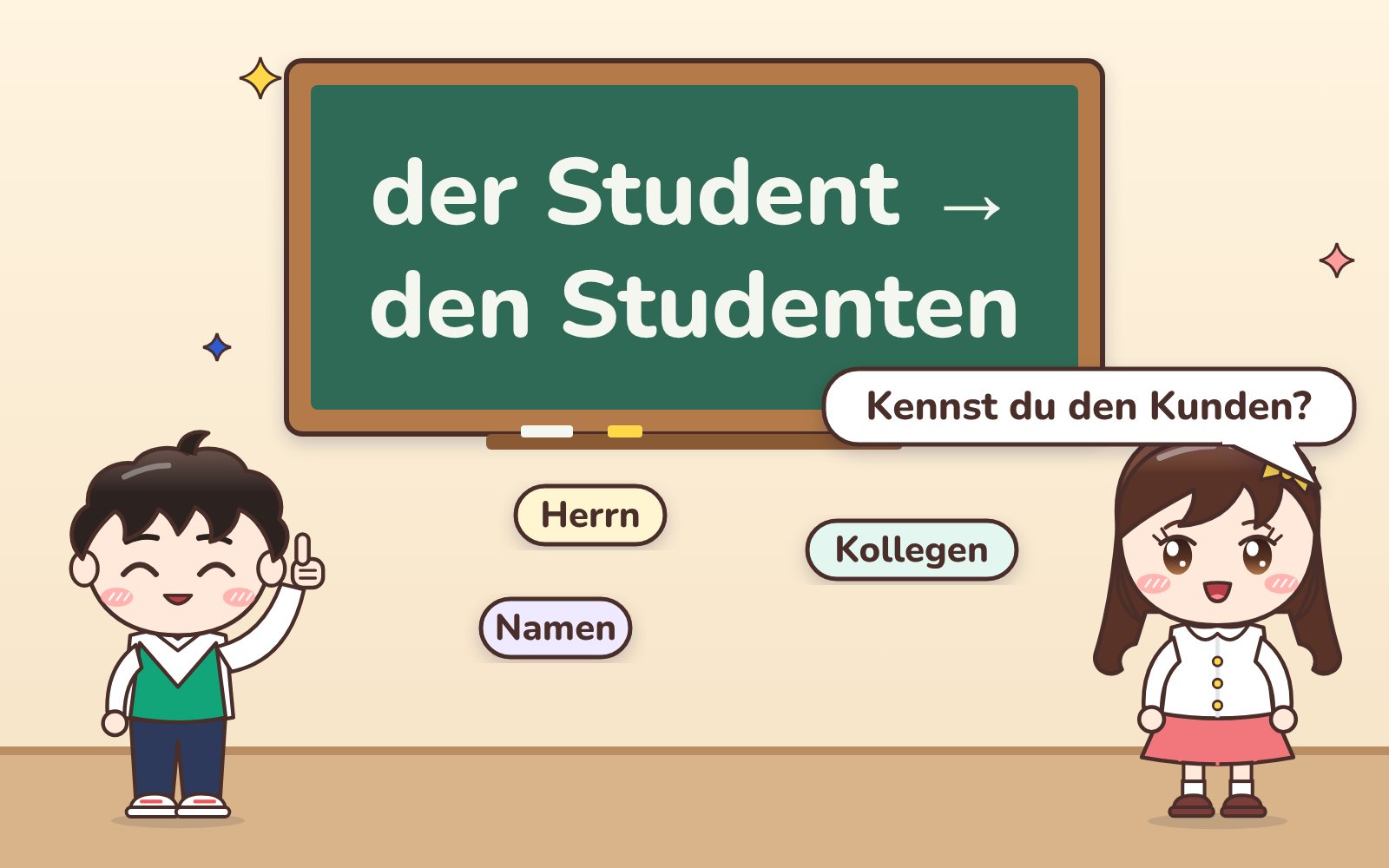
"I know the student" in German isn't Ich kenne den Student but Ich kenne den Studenten. Notice the -en on the end? Most German nouns hardly change their form from case to case (apart from the -s in the genitive). But a group of masculine nouns adds -n / -en in the accusative, dative and genitive — every case except the nominative. This is called the n-declension (die n-Deklination). There aren't many of these nouns, but they include everyday words like Kunde, Kollege, Nachbar and Herr, so they're well worth knowing.
The rule: -(e)n everywhere except the nominative
| Case | Singular | Plural |
|---|---|---|
| Nominative | der Student | die Studenten |
| Accusative | den Studenten | die Studenten |
| Dative | dem Studenten | den Studenten |
| Genitive | des Studenten | der Studenten |
Words ending in -e just add -n; all the others add -en: der Kunde → den Kunden, der Student → den Studenten. The plural has the same form, which makes it easy to remember.
- Der Student wohnt im dritten Stock. — The student lives on the third floor (US: fourth floor). (nominative, so no ending)
- Ich kenne den Studenten. — I know the student. (accusative)
- Die Verkäuferin hilft dem Kunden. — The shop assistant helps the customer. (dative)
- Das ist das Fahrrad meines Kollegen. — This is my colleague's bike. (genitive)
- Wir haben einen neuen Nachbarn. — We've got a new neighbour. (accusative)
Which nouns follow the n-declension?
They're all masculine, and most are people or animals. The ending usually gives them away.
| How to spot them | Examples |
|---|---|
| masculine, ending in -e (people, animals) | der Kunde, der Kollege, der Junge, der Neffe, der Löwe, der Affe |
| -ent, -ant, -ist | der Student, der Präsident, der Praktikant, der Polizist, der Tourist |
| -at, -oge, -graf | der Kandidat, der Soldat, der Biologe, der Fotograf |
| just learn these | der Herr, der Mensch, der Nachbar, der Bauer, der Bär |
- Der Polizist fragt den Touristen nach dem Weg. — The police officer asks the tourist the way. (den Touristen: accusative)
- Ich schreibe dem Präsidenten einen Brief. — I'm writing a letter to the president.
- Kennst du den Jungen da drüben? — Do you know that boy over there?
Careful! Der Käse also ends in -e, but it's not an n-declension noun (den Käse). If it isn't a person or animal, it usually doesn't belong here.
Herr and Name: two special words
der Herr adds -n in the singular and -en in the plural: den Herrn, die Herren. That's also why envelopes are addressed to Herrn Max Müller: it's the accusative form, meaning "to (someone)".
- Ich spreche mit Herrn Wagner. — I'm talking to Mr Wagner.
- Sehr geehrte Damen und Herren, — Dear Sir or Madam, (plural)
der Name adds -n in the accusative and dative, but -ns in the genitive: den Namen, dem Namen, des Namens. Der Gedanke (thought), der Buchstabe (letter of the alphabet) and der Glaube (belief) work the same way.
- Wie war noch mal Ihr Name? — Ich habe den Namen vergessen. — What was your name again? — I've forgotten the name.
- Die Bedeutung des Namens ist schön. — The name has a lovely meaning.
Common mistakes
- ✗ Ich habe einen Kollege angerufen. → ✓ Ich habe einen Kollegen angerufen. (accusative, so -n)
- ✗ Ich spreche mit Herr Schmidt. → ✓ Ich spreche mit Herrn Schmidt. (dative, so Herrn)
- ✗ Der Studenten kommt aus Korea. → ✓ Der Student kommt aus Korea. (nominative singular: no ending)
Quick check
- Ich helfe dem ___ beim Umzug. (Nachbar, neighbour)
Answer
Nachbarn — helfen takes the dative, and der Nachbar is an n-declension noun, so dem Nachbarn.- Wie ist der ___ des Hotels? / Ich kenne den ___ nicht. (Name)
Answer
Name / Namen — no ending in the nominative; the accusative is den Namen.- Das ist die Tasche des ___. (Kunde, customer)