German lessons · German grammar · B1
Können Sie mir sagen, wo …? Asking politely with indirect questions
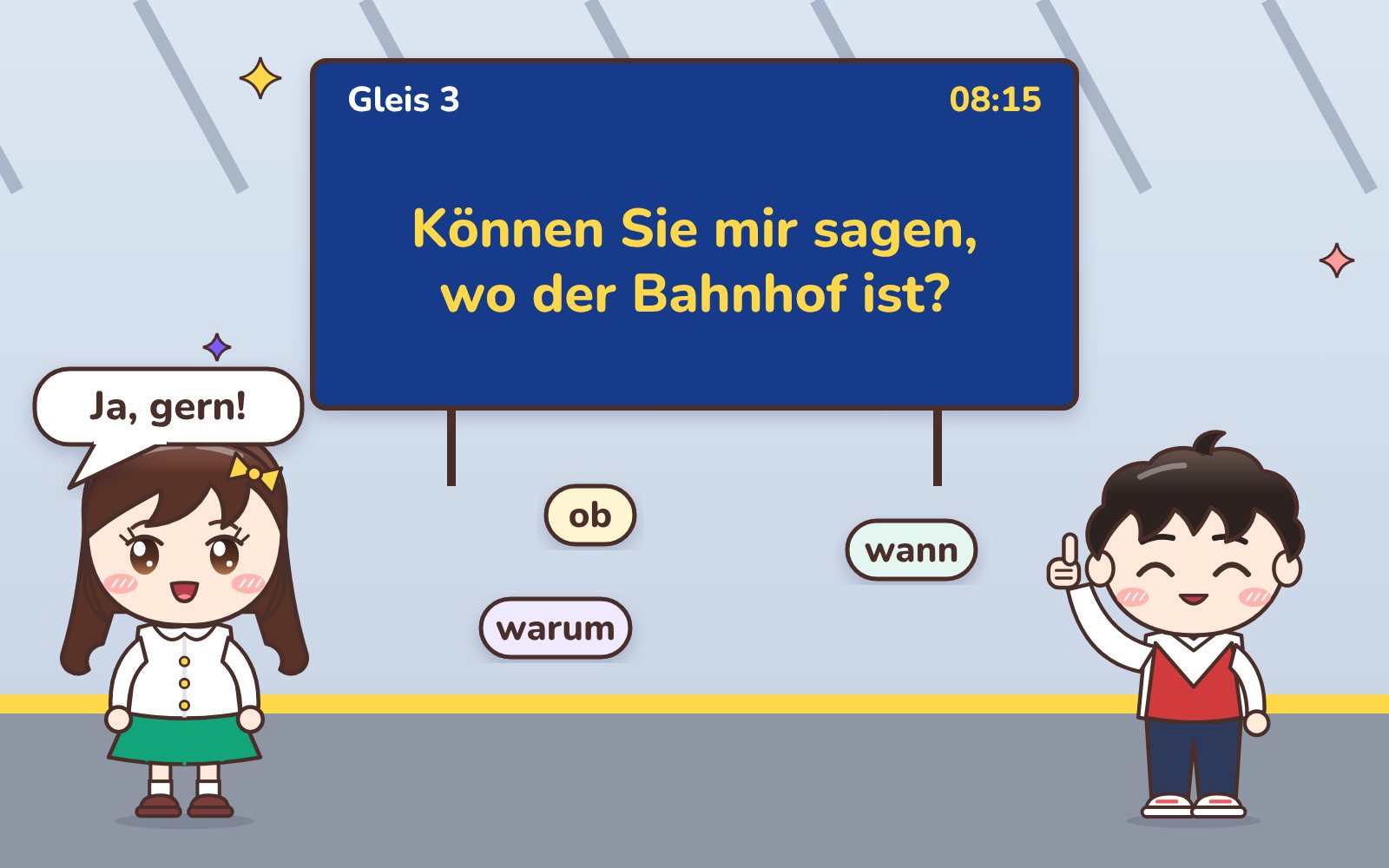
When you ask a stranger the way, just saying Wo ist der Bahnhof? isn't wrong. But at a government office, in a shop or with someone you've never met, you might want to sound a little softer. Germans do this the same way English speakers do: they put the question inside another sentence. Können Sie mir sagen, wo der Bahnhof ist? (Could you tell me where the station is?) A question tucked inside a sentence like this is called an indirect question (indirekte Frage). There are just two rules: what it starts with, and where the verb goes.
Rule 1: the verb goes to the end
An indirect question is a subordinate clause (Nebensatz). That means the conjugated verb goes right at the end. The subject comes straight after the question word. English does something similar — "where is the station?" becomes "where the station is" — but German sends the verb all the way to the end.
| Direct question | Indirect question |
|---|---|
| Wo ist der Bahnhof? | Können Sie mir sagen, wo der Bahnhof ist? |
| Wann kommt der Bus? | Wissen Sie, wann der Bus kommt? |
| Warum hat er abgesagt? | Ich weiß nicht, warum er abgesagt hat. |
| Wie viel kostet das? | Darf ich fragen, wie viel das kostet? |
If there are two verbs (perfect tense, modal verbs), the conjugated verb goes last: …, warum er abgesagt hat. / …, wann ich kommen kann. Separable verbs join up again: Der Zug fährt um 8 Uhr ab. → Wissen Sie, wann der Zug abfährt?
Rule 2: keep the question word, or use ob
What the indirect question starts with depends on the kind of question.
- W-questions (wo, wann, warum, wie, was, wer, welcher …) → keep the question word
- Yes/no questions (Kommt er? Ist das richtig?) → use ob (whether, if)
| Direct question | Indirect question |
|---|---|
| Ist der Platz frei? | Wissen Sie, ob der Platz frei ist? |
| Haben Sie heute geöffnet? | Ich wollte fragen, ob Sie heute geöffnet haben. |
| Kann ich mit Karte zahlen? | Können Sie mir sagen, ob ich mit Karte zahlen kann? |
Don't mix up ob and wenn. In English if can mean both, but in German "if" in the sense of "whether" is always ob. wenn is only for conditions and time ("if/when something happens").
Polite question frames
Learn the first part of the sentence and you can make any question polite. If the frame is a question, end with a question mark; if it's a statement, end with a full stop.
- Können Sie mir sagen, wo die Toiletten sind? — Could you tell me where the toilets are?
- Wissen Sie, wann die nächste S-Bahn fährt? — Do you know when the next S-Bahn leaves?
- Könnten Sie mir bitte erklären, wie das funktioniert? — Could you explain how this works, please?
- Ich möchte gern wissen, ob ich einen Termin brauche. — I'd like to know whether I need an appointment.
- Darf ich fragen, was Sie beruflich machen? — May I ask what you do for a living?
- Ich weiß nicht, ob ich morgen Zeit habe. — I don't know if I'll have time tomorrow.
You'll use these a lot in e-mails, too: Ich wollte fragen, ob die Wohnung noch frei ist. (I wanted to ask whether the flat is still available.)
Not only in questions
Indirect questions aren't just for asking things. They often come after verbs like wissen, fragen, sagen, erklären, überlegen and keine Ahnung haben.
- Ich habe keine Ahnung, wer das gesagt hat. — I've no idea who said that.
- Wir überlegen noch, wohin wir fahren. — We're still thinking about where to go.
Common mistakes
- ❌ Können Sie mir sagen, wo ist der Bahnhof? → ✅ Können Sie mir sagen, wo der Bahnhof ist? (the verb goes to the end)
- ❌ Wissen Sie, wenn der Laden heute offen ist? → ✅ Wissen Sie, ob der Laden heute offen ist? ("whether" is ob)
- ❌ Ich weiß nicht, wann fährt der Zug ab. → ✅ Ich weiß nicht, wann der Zug abfährt. (separable verbs join up again, at the end)
Quick check
- Turn Wo wohnt sie? into an indirect question starting with Weißt du, …
Answer
Weißt du, wo sie wohnt?- Turn Ist das Museum montags geöffnet? into an indirect question starting with Können Sie mir sagen, …
Answer
Können Sie mir sagen, ob das Museum montags geöffnet ist? It's a yes/no question, so use ob.- Fill the gap: Ich weiß nicht, wann der Film ___ . (anfangen)