German lessons · German exam guides · A2–B1
DTZ: the German test at the end of the integration course
If you take an Integrationskurs (integration course) in Germany, the language course ends with the Deutsch-Test für Zuwanderer (DTZ). It was developed by the Goethe-Institut on behalf of the Federal Ministry of the Interior. The special thing about it: everyone sits the same test, and your result decides whether you get A2 or B1.
Who takes the DTZ
The general integration course has a language course of 600 lessons (Unterrichtseinheiten) and an Orientierungskurs of 100 lessons. The DTZ is the final test of the language part. Participants of the special course types (for example literacy courses or youth integration courses) also finish with the DTZ; for youth courses there is a youth version of the test.
One test, two possible levels
The DTZ is a scaled test: you do not choose a level in advance. Depending on how well you do, the certificate shows B1 or A2 as the overall result. If you stay below A2, you get no certificate, only a notice of your result.
To get B1 (or A2) overall, you need that level in Sprechen and in at least one of the other two parts (Hören/Lesen or Schreiben).
The four parts
The written exam takes 100 minutes in total. The oral exam is done in pairs and takes about 15 minutes.
| Part | What you do | Time |
|---|---|---|
| Hören | announcements, phone messages, radio, short conversations and opinions | about 25 min |
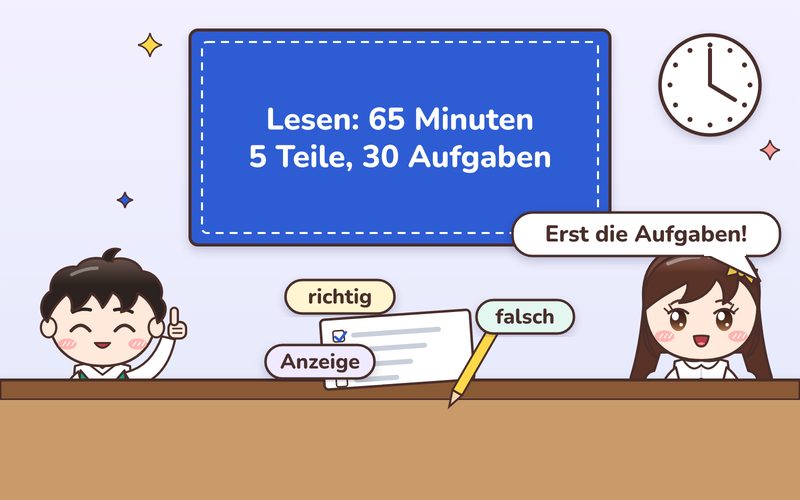
| Lesen | directories, adverts, official notices, brochures, a formal letter | 45 min |
| Schreiben | one short letter or e-mail, e.g. to an authority or landlord | 30 min |
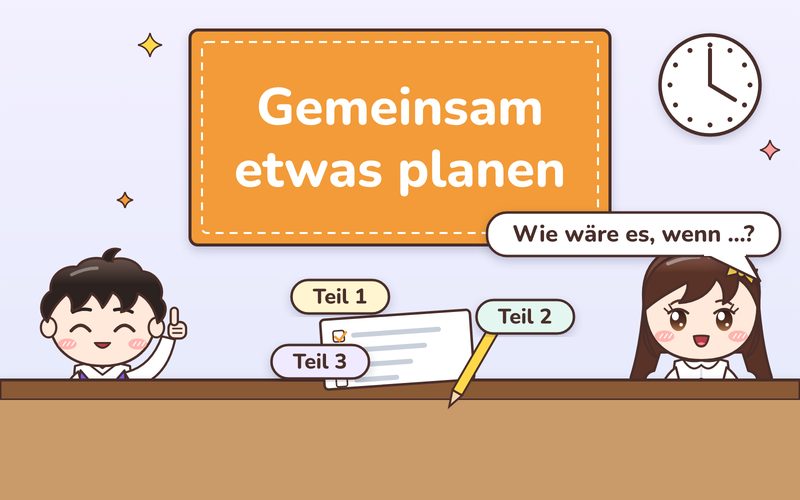
| Sprechen | introduce yourself, talk about a picture or experience, plan something with your partner | about 15 min (pair) |
Hören and Lesen are scored together. Schreiben and Sprechen are assessed by examiners using fixed criteria.
What B1 is used for
- Zertifikat Integrationskurs: you receive it with B1 in the DTZ plus a pass in the "Leben in Deutschland" test.
- Einbürgerung (citizenship): according to the BAMF you need German at B1; the DTZ at B1 counts as proof.
- Niederlassungserlaubnis (permanent residence): the general rule asks for sufficient German (usually B1) and basic knowledge of the legal and social order, both of which the Zertifikat Integrationskurs proves. Some residence titles have other rules, so check with your Ausländerbehörde.
If you only reach A2, you can, under certain conditions, repeat up to 300 lessons once; this includes one free retake of the exam.
Orientierungskurs and "Leben in Deutschland"
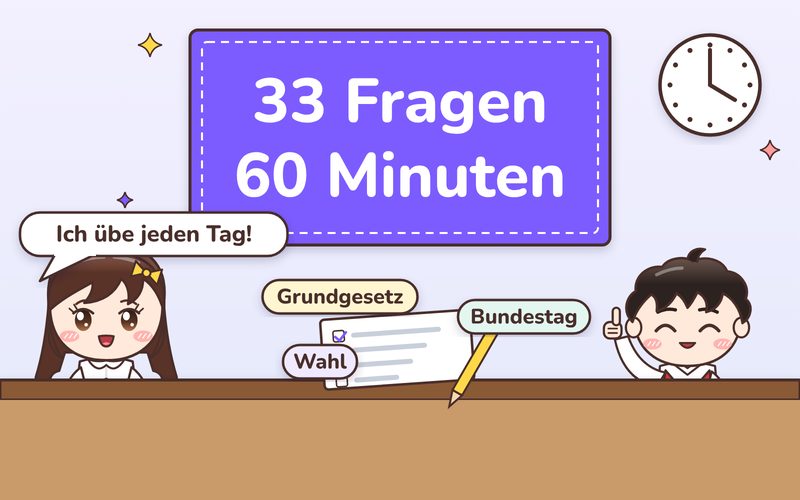
After the language course comes the Orientierungskurs (law, history, society). It ends with the "Leben in Deutschland" test, taken on a separate day: 33 multiple-choice questions in 60 minutes. 15 correct answers pass the course; 17 also count for Einbürgerung. More in our next guide.
How to register
Course participants do not register on a website. The DTZ is part of your integration course, and your course provider (Kursträger) registers you and tells you the date and place. Questions about costs and retakes: ask your provider, your Ausländerbehörde or a migration counselling service (MBE / Jugendmigrationsdienst).
How to prepare
- Do the free Modellsatz (sample test with audio) and the online practice tasks on goethe.de.
- Practise writing short formal messages: greeting, reason, request, closing (Sehr geehrte Damen und Herren, … Mit freundlichen Grüßen).
- Practise the oral exam with a classmate: introduce yourself in two minutes, then plan something together ("Wann treffen wir uns? Was bringen wir mit?").
- Speaking counts most: without the required level in Sprechen you cannot get B1 or A2 overall.
Sources: BAMF – Abschlussprüfung · BAMF – Einbürgerung · Goethe-Institut – Integrationskurssystem · Goethe-Institut – DTZ practice