German lessons · German exam guides · B1
B1 reading: you don't have to read every word — skimming, scanning and managing your time
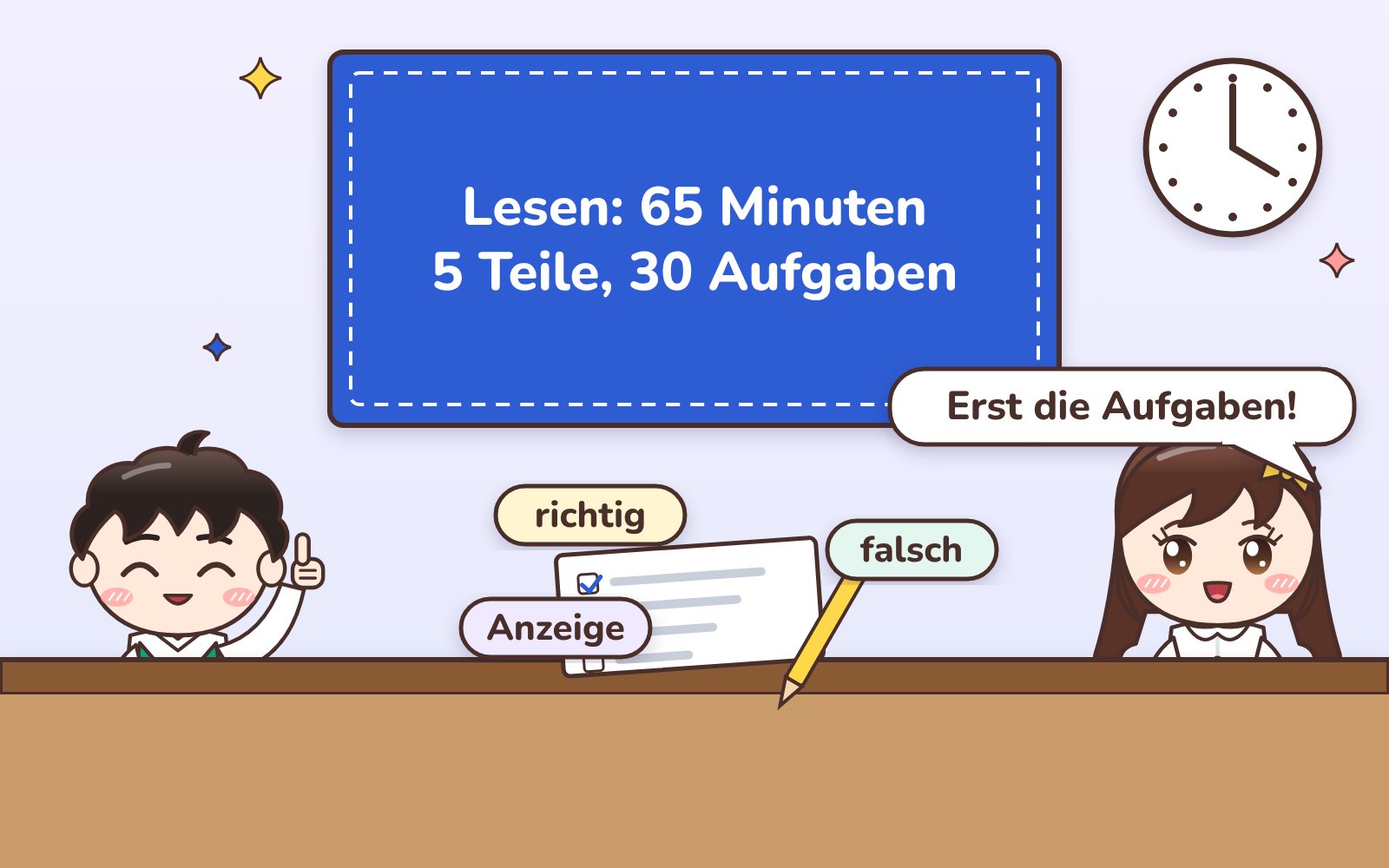
The most common mistake in a reading exam is reading every text carefully from beginning to end. Do that and you'll run out of time in the last part. In B1 reading, each part calls for a different way of reading: in some you only need the general idea, in some you just look for numbers and conditions, and in some you have to weigh up every sentence. This guide focuses on the Goethe B1 (adults) reading module, with a comparison for anyone taking the DTZ, the German test for immigrants. The whole exams are explained in our Goethe certificate overview and DTZ and the integration course.
What this part looks like
Based on the Goethe-Institut's official practice set (Übungssatz) and exam regulations (Durchführungsbestimmungen):
| Part | Type of text | Questions | Format | Suggested time |
|---|---|---|---|---|
| Teil 1 | a blog post or personal e-mail (about 330 words) | 6 | richtig / falsch | 10 min |
| Teil 2 | two newspaper articles | 6 | a / b / c | 20 min |
| Teil 3 | 10 ads + 7 situations | 7 | choose the right ad for each situation | 10 min |
| Teil 4 | 7 readers' opinions | 7 | ja / nein (is the person in favour?) | 15 min |
| Teil 5 | rules or instructions (e.g. the rules of a gym) | 4 | a / b / c | 10 min |
- 65 minutes, 30 questions in total — you can do the parts in any order you like
- No extra time for the answer sheet — you have to transfer your answers to the answer sheet (Antwortbogen) within the 65 minutes. The official regulations suggest allowing about 5 minutes
- No dictionaries or phones — and write in pen, not pencil
- No marks taken off for wrong answers — always choose an answer, even if you don't know
- Pass mark — the reading module has 100 points, and you pass with 60 or more
If you're taking the DTZ: DTZ reading is 45 minutes, five parts and 25 questions. You choose where to go from a sign in a building, match ads (marking X if no ad fits), read articles and notices, read terms and conditions, and fill gaps in a letter. The format is different, but the tips below work just as well.
Step by step
1. Read the questions first. Before you read a text, look at the questions and the example (0), and underline the key words in the questions. If you know what you're looking for, you'll read much faster.
2. Teil 1: first two sentences → questions → whole text. The first two sentences tell you who is writing to whom and about what. Then read the questions, then the text.
3. Teil 2: the order can be mixed up. The questions on the newspaper articles may not follow the order of the text. Pick a key word for each question, find the paragraph where that topic comes up, and read only that part carefully.
4. Teil 3: read the situations carefully, skim the ads. First mark the conditions in each situation (who, when, how much, where), then skim the ads quickly. At first several ads seem to fit, so compare just your two or three best candidates in detail. Cross out an ad once you've used it. There's exactly one situation with no matching ad, and for that one you write 0.
5. Teil 4: look at the opinion as a whole. Opinion texts mix in arguments for the other side, like "of course there are disadvantages, but…". Don't let one sentence throw you: decide whether the writer is for or against in the end.
6. Teil 5: use the bold subheadings. Rules and instructions have subheadings, so you can quickly find the section a question is about. The answer to each question is in one place.
7. Watch the clock, and move on if you get stuck. Check the time after each part. Mark a hard question with ? and come back to it later. Use the last 5 minutes to fill in the answer sheet and check you haven't slipped down a line.
Spotting the trap: same meaning, different words
The questions and the text often don't use the same words. The right answer is usually a sentence that says the same thing in other words. And the other way round: a sentence that uses exactly the same words as the text is sometimes the wrong answer. Also, base your answer only on what the text says, not on what you know about the world.
- Der Kurs ist kostenlos. = Man muss nichts bezahlen. — The course is free = you don't have to pay anything
- Das Geschäft hat sonntags geschlossen. = Am Sonntag kann man dort nicht einkaufen. — The shop is closed on Sundays
- Anmeldung erforderlich. = Man muss sich vorher anmelden. — Registration required
- Er war nicht begeistert. = Es hat ihm nicht so gut gefallen. — He didn't really like it
- Ich bin dagegen, dass … = Die Person ist gegen … — I'm against …
- Haustiere sind nicht erlaubt. = Man darf keine Tiere mitbringen. — No pets allowed
- ab 18 Jahren = nur für Erwachsene — 18 and over / adults only
- Der Eintritt ist frei. = Es kostet keinen Eintritt. — Admission is free
Common mistakes
- ❌ Stopping at every word you don't know → ✅ first ask yourself whether you need that word to answer the question. Usually you can answer without it
- ❌ Answering from general knowledge → ✅ only use what's written in the text
- ❌ Writing '0' several times in Teil 3 → ✅ in Goethe B1 there's only one situation with no matching ad
- ❌ Filling in the answer sheet in the last minute → ✅ leave 5 minutes, and check the numbers and lines
- ❌ Leaving gaps → ✅ wrong answers cost nothing, so answer every question
Practice plan
| Day | What to do |
|---|---|
| 1 | Do the reading part of the official practice set with no time limit, and note where you got stuck in each part |
| 2 | Focus on Teil 3: underline the conditions in the situations and practise skimming the ads |
| 3 | Teil 1 and 5: work in the order first two sentences → questions → text, 10 minutes each with a timer |
| 4 | Teil 2 and 4: find "same meaning, different words" pairs in the articles and opinions and collect them in a notebook |
| 5 | Skim a German newspaper article in 3 minutes and sum it up in one sentence |
| 6 | Do the whole reading part of the model test (Modellsatz) in 65 minutes, including the answer sheet |
| 7 | Go back over the questions you got wrong and note why (time, vocabulary, a trap) |
Free official material: B1 Übungssatz Erwachsene (PDF) · B1 Modellsatz Erwachsene (PDF) · online practice test · Goethe B1 reading tips, "Tipps und Tricks" (PDF) · DTZ practice test (telc, PDF)
Quick check
- In Goethe B1 reading Teil 3, what do you write for the situation with no matching ad?
Answer
0. There's only one situation like that. (In the DTZ you mark X.)- Do you get extra time to fill in the answer sheet?
Answer
No. You have to do it within the 65 minutes, so leave about 5 minutes for it.- Which sentence in a text means the same as Man muss nichts bezahlen. in a question? (a) Der Kurs ist kostenlos. (b) Der Kurs ist teuer. (c) Man muss sich anmelden.
Answer
(a) Der Kurs ist kostenlos. It says the same thing in different words.Sources: B1 Übungssatz Erwachsene (goethe.de) · Durchführungsbestimmungen B1 (goethe.de) · Tipps und Tricks B1 Lesen (goethe.de) · Tipps zur Prüfungsvorbereitung (Goethe-Institut Prag) · DTZ Übungstest 1 (telc) · Prüfungstraining telc Deutsch B1, Probekapitel (telc)