German lessons · German exam guides · B1
310 questions, don't panic — smart ways to learn the Leben in Deutschland and citizenship test questions
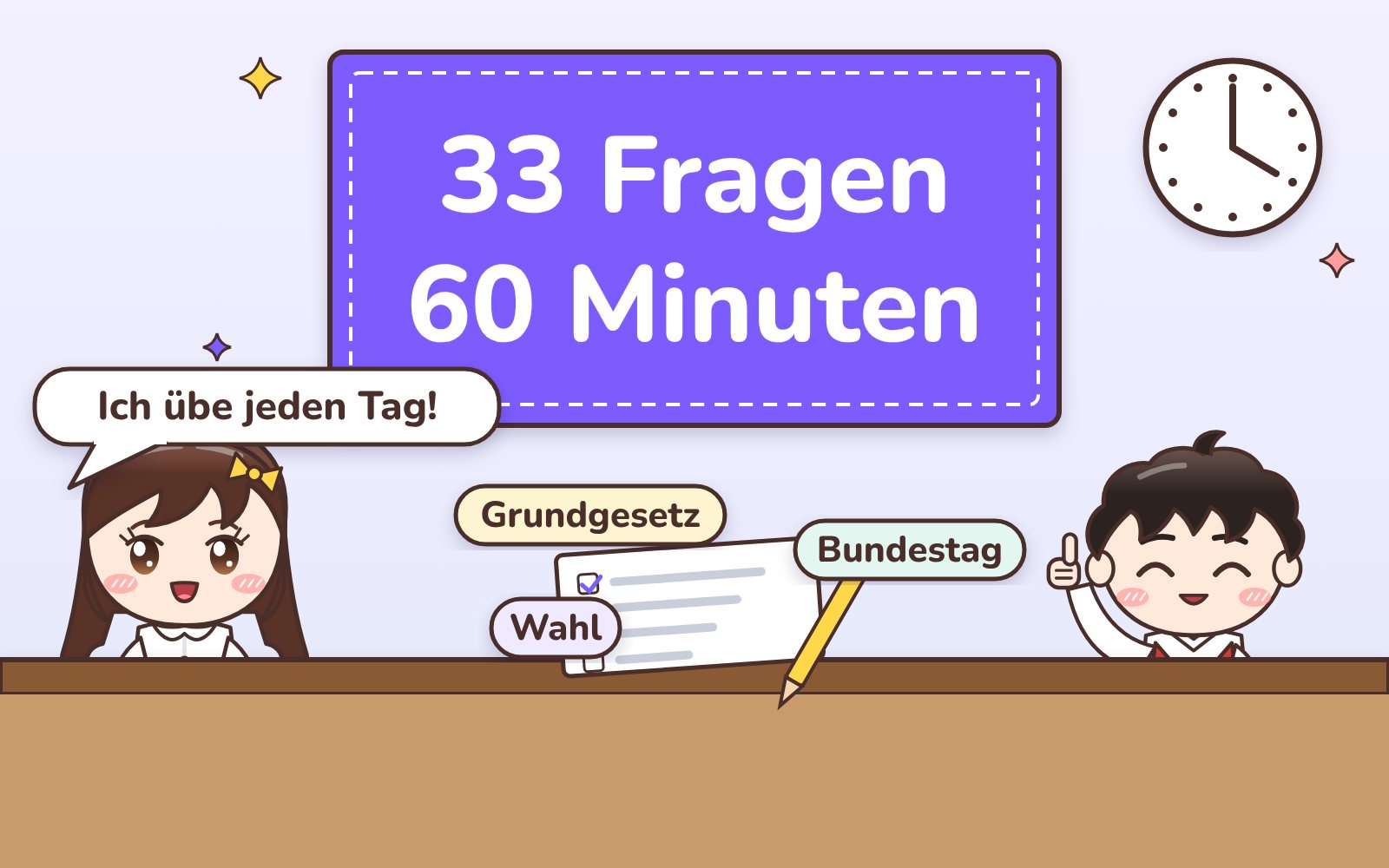
For the "Leben in Deutschland" (LiD) test and the citizenship test (Einbürgerungstest), how you prepare matters more than how good your German is — all the questions are public. Still, 310 questions can feel overwhelming. This post is about how to learn them so it's less work and they stick. What the two tests are and who takes them is explained first in our guide to the citizenship test and the Leben in Deutschland test.
What the test looks like
According to BAMF, both tests have the same format.
| Item | Details |
|---|---|
| Question bank | 310 questions = 300 general questions + 10 about your federal state |
| Test paper | 33 questions = 30 general + 3 about your state, picked at random from the bank |
| Format | 4 options per question, one correct answer |
| Time | 60 minutes |
| Pass | citizenship test 17 or more · LiD test 15 or more (17 or more also counts for citizenship) |
Because the questions are picked at random, you need to cover all 310. The good news: the wording is exactly the same, so any question you have understood and learned, you'll recognise straight away in the exam.
Step by step
Step 1 — get the official material first. BAMF's complete question catalogue PDF (Gesamtfragenkatalog) and its Online-Testcenter are free. Even if you use another app or book, always check the questions against the official wording.
Step 2 — finish your state's 10 questions first. In the Online-Testcenter, choose the state you live in and you get the 300 general questions plus that state's 10. There are only 10 state questions, yet 3 of them appear in the test — the most efficient study you can do.
Step 3 — split the 300 questions by topic. Don't go from number 1 to 300. Group 30–40 questions a day by topic. A good order is the Basic Law (Grundgesetz) and basic rights → state institutions and elections → history (the Nazi era, division and reunification) → society and everyday life (family, education, religion, work), so each topic builds on the last.
Step 4 — don't just learn the answer, learn the "why". The test centre shows the correct answer for each question right away. Note every question you get wrong with a one-line reason (e.g. Bundesrat = the representation of the state governments). If you know the reason, a different order of the options won't confuse you.
Step 5 — practise with mock tests. The test centre's mock test gives you 33 questions and shows your score, the correct answers and short explanations at the end. Time yourself for 60 minutes; once you get 30 or more three times in a row, you're ready.
In the exam. Answer the questions you know quickly, mark the tricky ones and come back to them. 60 minutes is fairly generous, so there's no need to rush. Don't forget your ID.
Useful German
Rather than learning whole sentences by heart, knowing the words that come up again and again makes the questions much quicker to read.
- das Grundgesetz — the Basic Law (Germany's constitution)
- die Meinungsfreiheit — freedom of expression
- die Gewaltenteilung — separation of powers
- der Bundestag / der Bundesrat — the federal parliament / the Federal Council (representing the state governments)
- der Bundeskanzler / der Bundespräsident — the Federal Chancellor / the Federal President
- Die Wahl ist frei und geheim. — Elections are free and secret.
- das Bundesland — federal state
- die Wiedervereinigung — (German) reunification
- Was bedeutet …? — What does … mean? (a common question format)
- Welches Recht gehört zu den Grundrechten? — Which right is one of the basic rights?
Common mistakes
- ❌ Studying only from an app's translation → ✅ The test is only in German. Use translations to understand, but at the end work through the German originals again
- ❌ Learning the position of the right answer ("this one is the third option") → ✅ Assume the order may differ in the exam and remember the answer itself
- ❌ Leaving the state questions until last → ✅ There are only 10 — finish them on day one
- ❌ Mixing up similar words (Bundestag ↔ Bundesrat, Bundeskanzler ↔ Bundespräsident) → ✅ Put the pairs side by side in a table
- ❌ Stopping after one mock test with more than 17 → ✅ 17 is the minimum. Keep going until you score high again and again
Practice plan (three weeks)
| When | What to do |
|---|---|
| Day 1 | Download the question catalogue PDF, choose your state in the test centre, finish the 10 state questions |
| Week 1 | 40 questions a day: Basic Law and basic rights, state institutions, elections (start your mistakes notebook) |
| Week 2 | 40 questions a day: history, society and everyday life + redo the previous day's mistakes |
| Week 3 | One mock test (60 min) every day + review your mistakes notebook, sort out confusing word pairs |
| Day before the test | Go through your mistakes notebook once more, go to bed early, pack your ID |
Free official material: BAMF Online-Testcenter · All LiD questions · LiD mock test · All citizenship test questions · Citizenship test mock test · Complete question catalogue (PDF)
Quick check
- Of the 33 questions on the test paper, how many are about your federal state?
Answer
Three. The state question bank has only 10, so learning them first pays off.- How many correct answers in the LiD test also count for citizenship?
Answer
17 or more. 15 or more is a pass in the LiD test.- What is der Bundesrat?
Answer
The Federal Council, the body through which the state governments take part in federal law-making. (The federal parliament is der Bundestag.)Sources: BAMF – Einbürgerung · BAMF – Online-Testcenter · BAMF – Abschlussprüfung · VHS Pankow – Einbürgerungstest · passexperten.de – Einbürgerungstest online