German lessons · German exam guides · B1
telc Deutsch B1 speaking test: how to prepare for all three parts, step by step
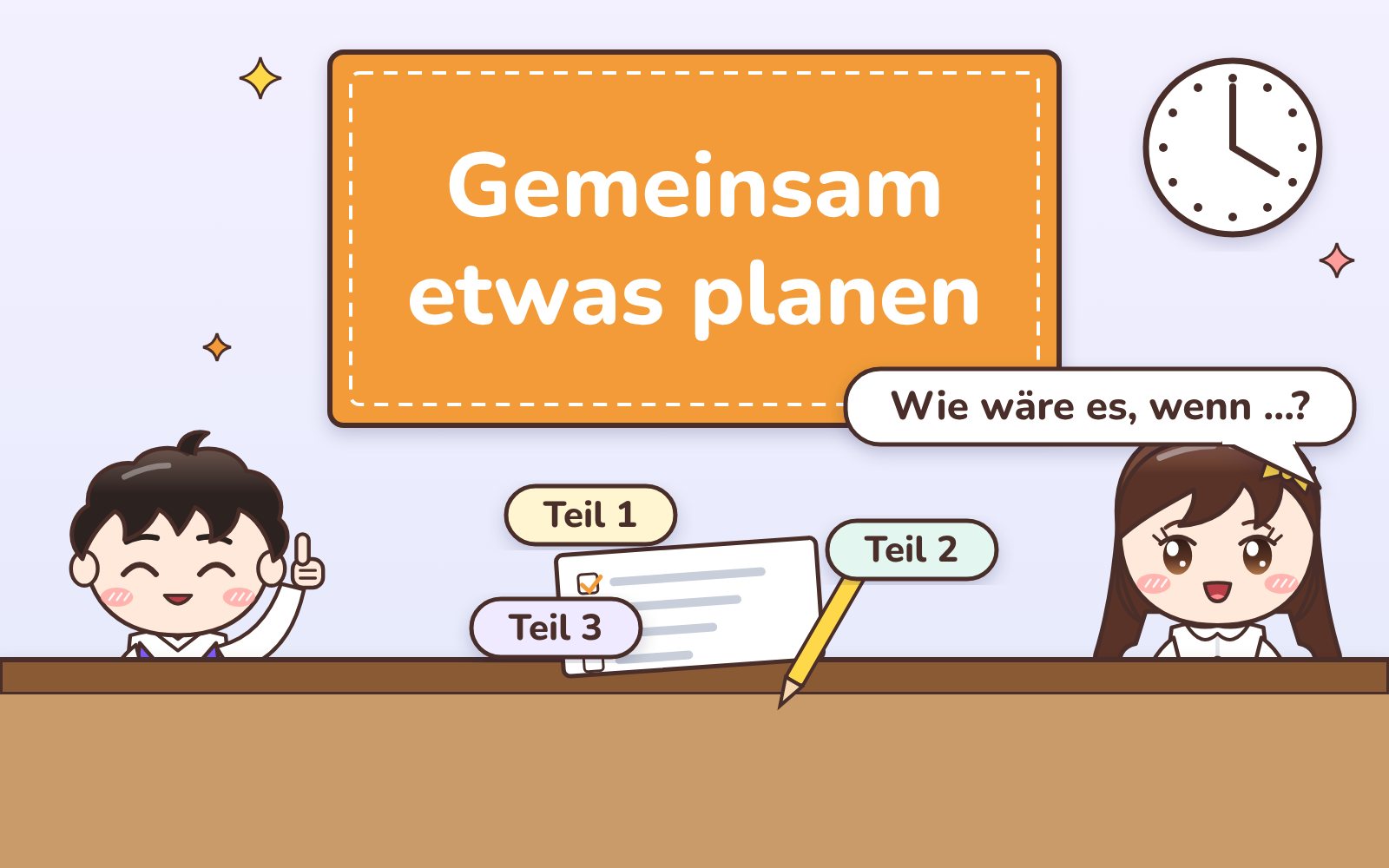
For many people preparing for telc Deutsch B1 (Zertifikat Deutsch), the part that causes the most nerves is the speaking test (die mündliche Prüfung). But this isn't a test where you give a talk on your own — it's a conversation between you and another candidate. That means keeping the conversation going matters more than perfect grammar. The structure of the whole exam is in our guide to telc exams; here we look closely at the speaking part only.
What the speaking test looks like
This comes from the official telc page and the official practice test (Übungstest 1).
| What you do | Time | Points | |
|---|---|---|---|
| Preparation | Make notes on your tasks (only on the stamped paper) | 20 min | — |
| Teil 1 · Einander kennenlernen | Getting to know each other: name, origin, where you live, family, where you learned German, work or studies, languages | about 3 min | 15 |
| Teil 2 · Über ein Thema sprechen | Talking about a topic: you each get a short text with a different opinion, present it and give your own view and experience | about 6 min | 30 |
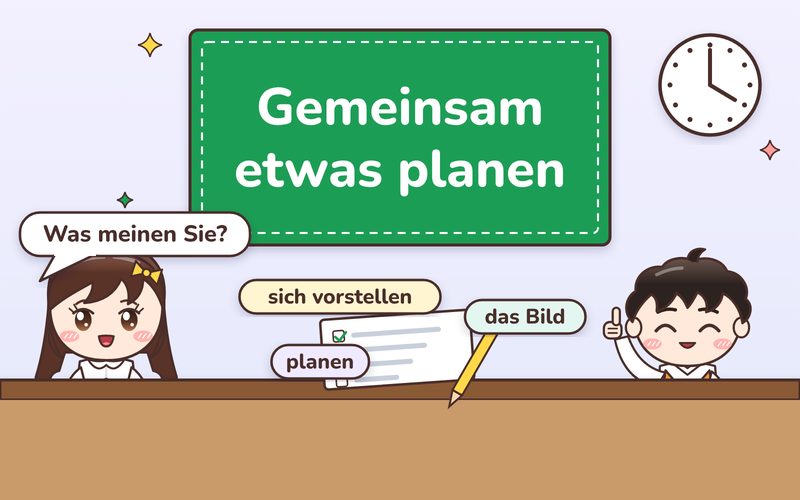
| Teil 3 · Gemeinsam etwas planen | Planning together: e.g. a leaving party — when, where, food, who pays for what | about 6 min | 30 |
- You take it together, in pairs. There are two examiners: one leads the conversation, the other watches and marks
- The test takes about 15 minutes, and speaking is worth 75 points in total. The official practice test says you need at least 45 of the 75 points in speaking
- In every part, four things are assessed: expression, task completion, grammatical accuracy, and pronunciation and intonation. The official material says that asking each other questions and helping each other out is rated positively
- You can't talk to your partner during the preparation time. You may look at your notes during the test, but you mustn't read them out
Step by step
- Preparation, 20 minutes: keywords, not sentences — for your Teil 2 text, note the main claim, your opinion and one example; for Teil 3, write one or two ideas for each point. If you have time left, also note questions to ask your partner
- Teil 1: decide on du or Sie first — settle it at the start and stick to it. Keep your answers short and always ask back. When the examiner asks more, answer in two or three sentences, not one
- Teil 2: don't read — use your own words — go in this order: topic → the author's opinion → your opinion → your experience or an example. Then move into the conversation by asking your partner "Wie siehst du das?" Comparing with your own country works well too
- Teil 3: cover every point, give reasons, agree at the end — don't just list suggestions; react to your partner's ideas. If you disagree, offer a compromise, and at the end sum up what you've decided
- Don't panic if your partner talks a lot — just come in politely with something like "Darf ich kurz etwas dazu sagen?"
Useful German
- Wollen wir uns duzen? — Shall we use du?
- Woher kommst du, und wie lange wohnst du schon hier? — Where are you from, and how long have you lived here?
- Ich lerne seit zwei Jahren Deutsch, jetzt an der Volkshochschule. — I've been learning German for two years, now at the adult education centre.
- In meinem Text geht es um das Thema Gruppenreisen. — My text is about group travel.
- Die Autorin ist der Meinung, dass man auf Gruppenreisen leicht Leute kennenlernt. — The author thinks it's easy to meet people on group trips.
- Meiner Meinung nach hat sie teilweise recht, aber … — In my opinion she's partly right, but …
- Wie ist das bei dir? Wie siehst du das? — What about you? How do you see it?
- Wie wäre es, wenn wir die Party am Samstagabend machen? — How about having the party on Saturday evening?
- Das ist zwar eine gute Idee, aber ich fände es besser, wenn … — That's a good idea, but I think it would be better if …
- Dann machen wir es so: Du kümmerst dich um die Getränke, und ich übernehme das Essen. — So let's do it like this: you take care of the drinks, and I'll handle the food.
Common mistakes
- Mixing du and Sie — stick with whatever you agreed at the start
- Reading out your Teil 2 text or your notes — the official material also says not to read from your notes
- One-word answers, long silences — if you don't understand, you can ask back, e.g. "Wie meinst du das?"
- Talking on your own for too long — Teil 3 in particular is a conversation where you plan together. Give your partner a chance too
- Memorising long sentences word for word — if they don't fit the situation, they sound odd. Practise using short phrases in lots of situations instead
Practice plan (one week)
| Day | What to do |
|---|---|
| 1 | Read the speaking part of the official Übungstest and the marking criteria |
| 2 | Teil 1: build short sentences introducing yourself from keywords; record and listen back |
| 3 | Teil 2: pick a newspaper article and speak for 3 minutes: opinion → your view → experience |
| 4 | Learn Teil 3 phrases: suggesting, agreeing, disagreeing, compromising |
| 5 | Practise Teil 3 with a partner (6-minute timer) |
| 6 | 20 minutes' preparation + a full 15-minute mock test |
| 7 | Listen to your recordings again and fix only the sentences you often get wrong |
Free official material: the telc Deutsch B1 exam page and the official practice test Übungstest 1 (PDF). The practice test includes the speaking tasks and the marking criteria.
Quick check
- How long is the preparation time in the telc B1 speaking test?
Answer
20 minutes. You can only make notes on the stamped paper.- How should you present the text you get in Teil 2?
Answer
Don't read it out: sum it up briefly in your own words, then give your opinion and experience.- In Teil 3, what can you say when you don't like your partner's suggestion?
Answer
For example: Das ist zwar eine gute Idee, aber ich fände es besser, wenn … — and then offer a compromise.Sources: telc.net – telc Deutsch B1 · telc Übungstest 1 Zertifikat Deutsch B1 (PDF) · deutsch-pruefung.de · germanup.org · dein-sprachcoach.de