German lessons · German grammar · A2
Ich werde … or Morgen gehe ich …? Talking about the future in German
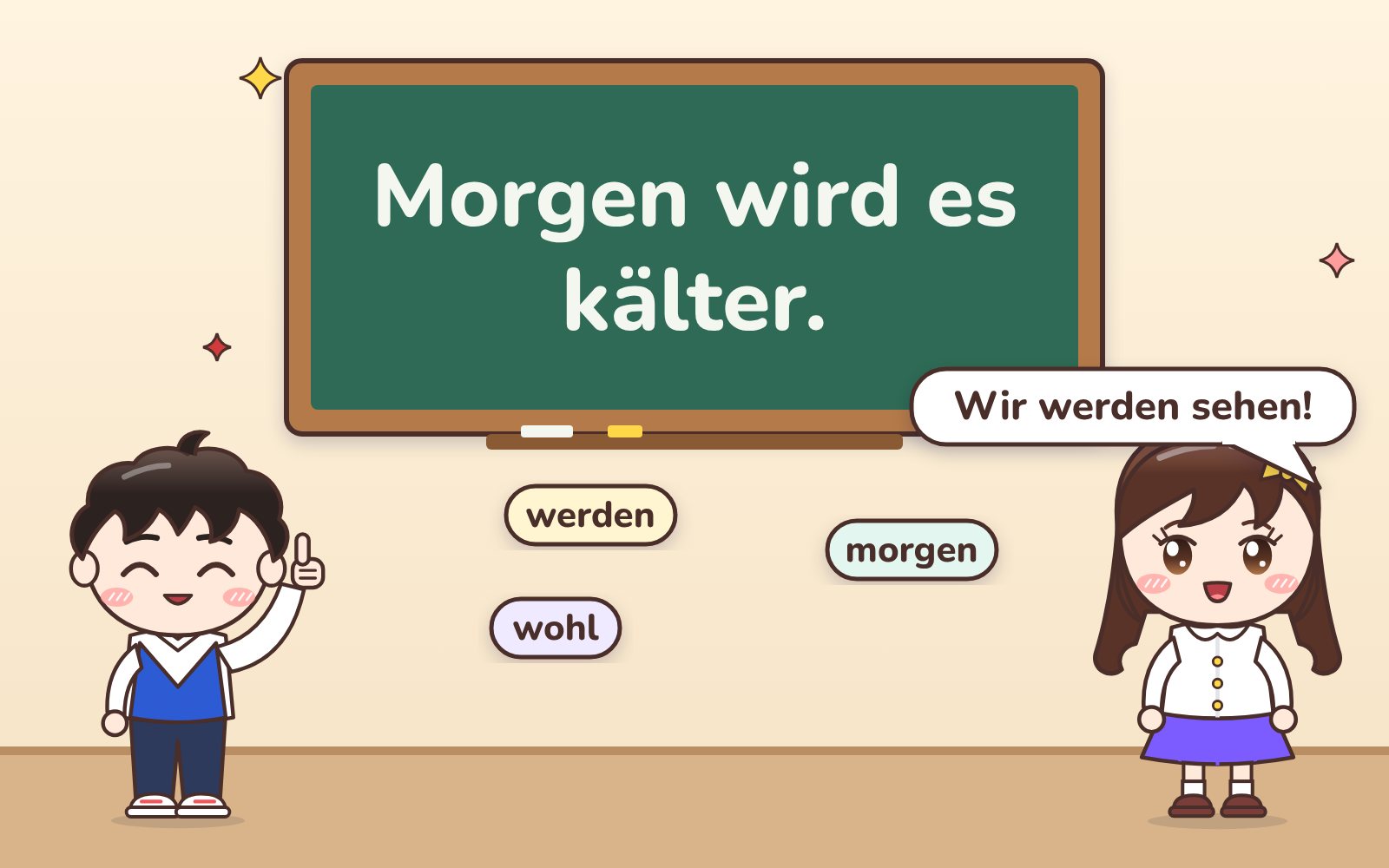
"I'm going to the cinema tomorrow", "We'll move next month", "He'll probably be at home by now" — German has two main ways to talk about the future: the present tense + a time phrase, and werden + infinitive. The surprise for many learners: in everyday conversation Germans use the present tense far more often. werden is mainly for promises, predictions, plans without a time phrase — and guesses. Once you know which one to use when, the future in German is easy.
Way 1: present tense + time phrase (the most common)
If a word tells us when (morgen, nächste Woche, am Samstag …), the verb simply stays in the present tense — just like English "I'm going tomorrow" or "The train leaves at six".
- Morgen gehe ich ins Kino. — I'm going to the cinema tomorrow.
- Nächste Woche fahren wir nach Hamburg. — We're going to Hamburg next week.
- Am Samstag besuche ich meine Eltern. — I'm visiting my parents on Saturday.
- Der Zug kommt um 18 Uhr an. — The train arrives at 6 pm.
When the time phrase comes first, the verb stays in second place and the subject moves behind it (Morgen gehe ich …).
Way 2: werden + infinitive
Put the right form of werden in second position and the infinitive at the very end of the sentence.
| Subject | werden | Example |
|---|---|---|
| ich | werde | Ich werde dich anrufen. |
| du | wirst | Du wirst das schaffen. |
| er / sie / es | wird | Es wird morgen regnen. |
| wir | werden | Wir werden umziehen. |
| ihr | werdet | Ihr werdet staunen. |
| sie / Sie | werden | Sie werden das Paket morgen bekommen. |
du wirst and er wird are irregular — learn them separately.
When do you use werden?
① Promises and firm intentions — a feeling of "I will, really". - Ich werde dich morgen anrufen, versprochen! — I'll call you tomorrow, I promise!
② Predictions and weather forecasts — you hear it on the news all the time. - Morgen wird es kälter. — It's going to get colder tomorrow.
③ No time phrase — without one, the present tense sounds like now, so werden makes the future clear. - Wir werden sehen. — We'll see.
By the way: on its own, werden means "to become". Ich werde Ärztin. means "I'm going to be / becoming a doctor", and Es wird dunkel. means "It's getting dark".
④ Guesses: "it'll probably be …" — werden can also express a guess about the present, often with wohl, bestimmt or sicher. - Er wird wohl noch im Büro sein. — He'll probably still be at the office. - Das wird schon klappen. — It'll work out.
Subordinate clauses and separable verbs
After conjunctions like weil and dass, werden goes to the very end. Separable verbs stay joined in the infinitive.
- Ich glaube, dass es morgen regnen wird. — I think it'll rain tomorrow.
- Wir werden am Montag umziehen. — We'll move on Monday. (umziehen stays in one piece.)
- Ich werde früh aufstehen. — I'll get up early.
Common mistakes
- ❌ Ich werde gehen morgen ins Kino. → ✅ Ich werde morgen ins Kino gehen. (The infinitive goes to the end.)
- ❌ Du werdest das schaffen. → ✅ Du wirst das schaffen. (The du form is wirst.)
- ❌ Morgen ich gehe ins Kino. → ✅ Morgen gehe ich ins Kino. (After a time phrase in first place, the verb comes second and the subject follows.)
Quick check
- Say it with the present tense, starting with am Freitag: Ich werde am Freitag arbeiten.
Answer
Am Freitag arbeite ich. — With a time phrase, the present tense is enough for the future.- Fill the gap: Er ___ das bestimmt wissen. (He'll surely know.)
Answer
wird — Er wird das bestimmt wissen. (werden for a guess)- Fix the word order: Ich weiß, dass sie wird kommen.