German lessons · Everyday German phrases · A2
Hast du Lust? Making plans, finding a time and cancelling in German
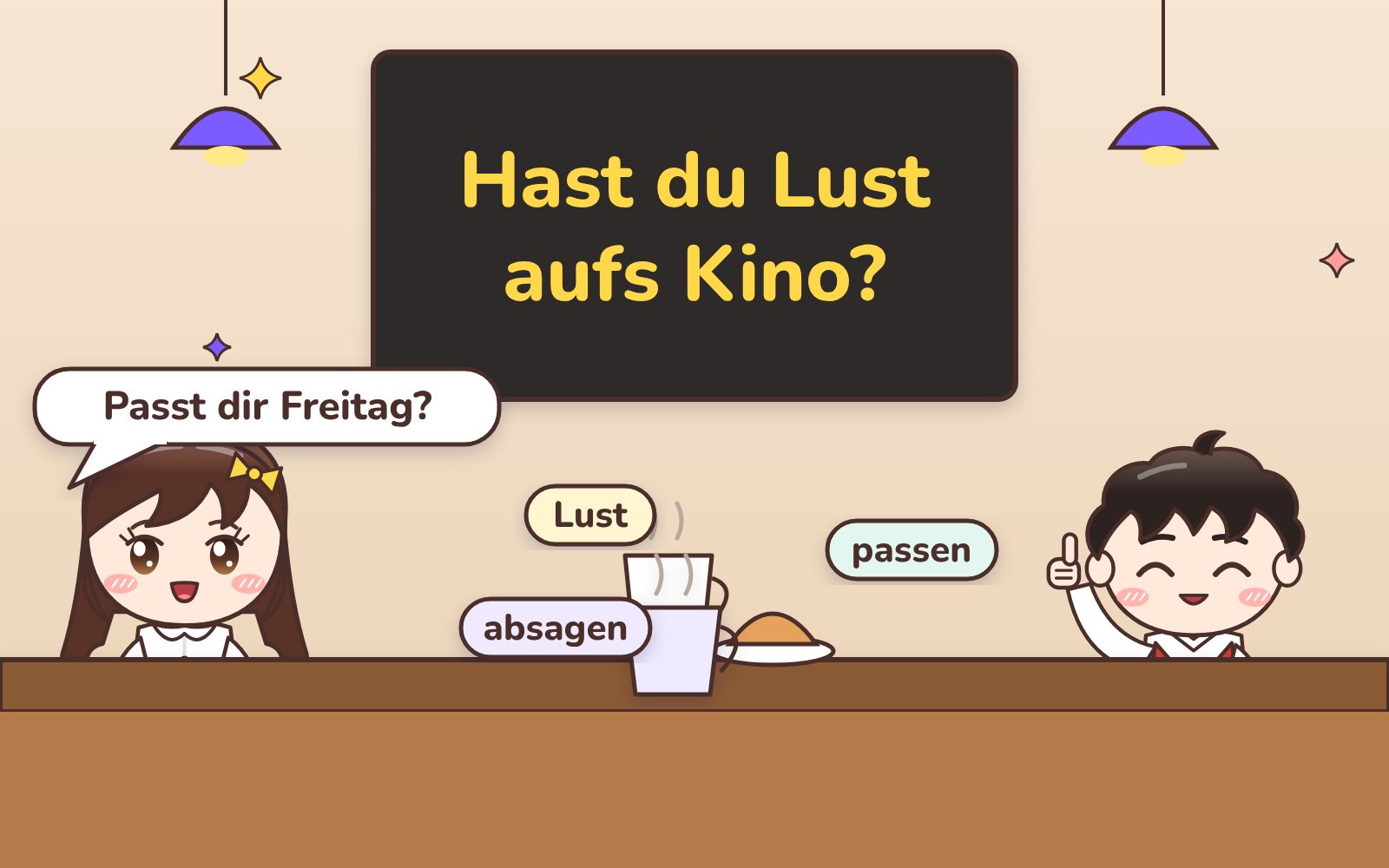
Germans tend to prefer plans made in advance to spontaneous meet-ups. Even among friends, people fix a date and time, like "How about next Thursday at seven?", and write it in their calendar. That's why the words for suggesting a plan, finding a time and letting people know early when something comes up matter so much. If you can't make it, simply not turning up without a word is seen as very rude. Today we'll focus on du phrases for friends and colleagues, and look at polite Sie phrases too.
Shall we? Making a suggestion
- Hast du Lust, ins Kino zu gehen? — Do you fancy going to the cinema? The most common way to suggest something. Lust haben means 'to feel like doing something'
- Hast du Lust auf einen Kaffee? — Do you fancy a coffee? With a noun, use auf
- Hast du am Samstag Zeit? — Are you free on Saturday? For checking first whether someone has time
- Wollen wir zusammen essen gehen? — Shall we go out for something to eat?
- Wie wäre es mit Freitag? — How about Friday? For suggesting a day or a place
- Kommst du mit? — Are you coming too? For inviting someone along to a plan that's already fixed
When suits you? Finding a time
- Wann passt es dir? — When suits you? passen takes the person in the dative (dir, Ihnen)
- Passt dir Donnerstag um sieben? — Does Thursday at seven work for you?
- Bei mir geht es erst ab acht. — I can't make it until eight.
- Am Wochenende kann ich leider nicht. — I'm afraid I can't at the weekend.
- Würde Ihnen Dienstag um 10 Uhr passen? — Would Tuesday at 10 suit you? At work or with people you don't know
Great! Saying yes
- Gern! — I'd love to!
- Klingt gut! — Sounds good!
- Das passt mir gut. — That works well for me.
- Abgemacht! — It's a deal! When the plan is fixed
- Bis Donnerstag dann! — See you on Thursday, then!
Sorry! Cancelling and putting things off
When you say no or cancel, adding leider (unfortunately, I'm afraid) and suggesting another day makes it sound much softer.
- Ich muss leider absagen. — I'm afraid I have to cancel.
- Mir ist leider etwas dazwischengekommen. — Something's come up, I'm afraid. Handy, because you don't have to explain in detail
- Können wir das verschieben? — Can we put it off?
- Vielleicht ein anderes Mal? — Maybe another time?
- Ich müsste unseren Termin leider absagen. — I'm afraid I'll have to cancel our appointment. Good for polite e-mails with Sie
Short dialogue
A: Hey Jana, hast du Lust, am Freitag ins Kino zu gehen? — Hey Jana, do you fancy going to the cinema on Friday? B: Freitag kann ich leider nicht. Wie wäre es mit Samstag? — I can't on Friday, I'm afraid. How about Saturday? A: Samstag passt mir gut. Um wie viel Uhr? — Saturday works for me. What time? B: Bei mir geht es erst ab sieben. — I can't make it until seven. A: Dann treffen wir uns um halb acht vor dem Kino. — Then let's meet at half past seven outside the cinema. B: Abgemacht! Bis Samstag! — Deal! See you on Saturday!
Watch out
- Lust haben is a neutral way of saying you feel like doing something. Ich habe keine Lust. (I don't feel like it) is fine among friends, but sounds rude at work. Da kann ich leider nicht. is the safe choice
- Passt du …? ❌ → Passt es dir …? / Passt dir …? ✅ — it means 'does it suit you', so the person is in the dative
- der Termin is an appointment at the doctor's, at an office or for work. A plan with friends is die Verabredung, and "we've arranged to meet" is Wir sind verabredet.
- absagen (to cancel, to say you can't come) and zusagen (to say you'll come) are opposites. If you answer an invitation with Ich sage zu., it means "I'll be there"
Quick check
- How do you ask a friend "Are you free on Saturday?" in German?
Answer
Hast du am Samstag Zeit?- What goes in the gap? Passt ___ Montag um neun? (asking someone you call du)
Answer
dir — Passt dir Montag um neun? passen takes the dative.- What do you say when something suddenly comes up and you have to cancel?