German lessons · German grammar · A1
Modal Verbs – können, müssen, dürfen & Co.
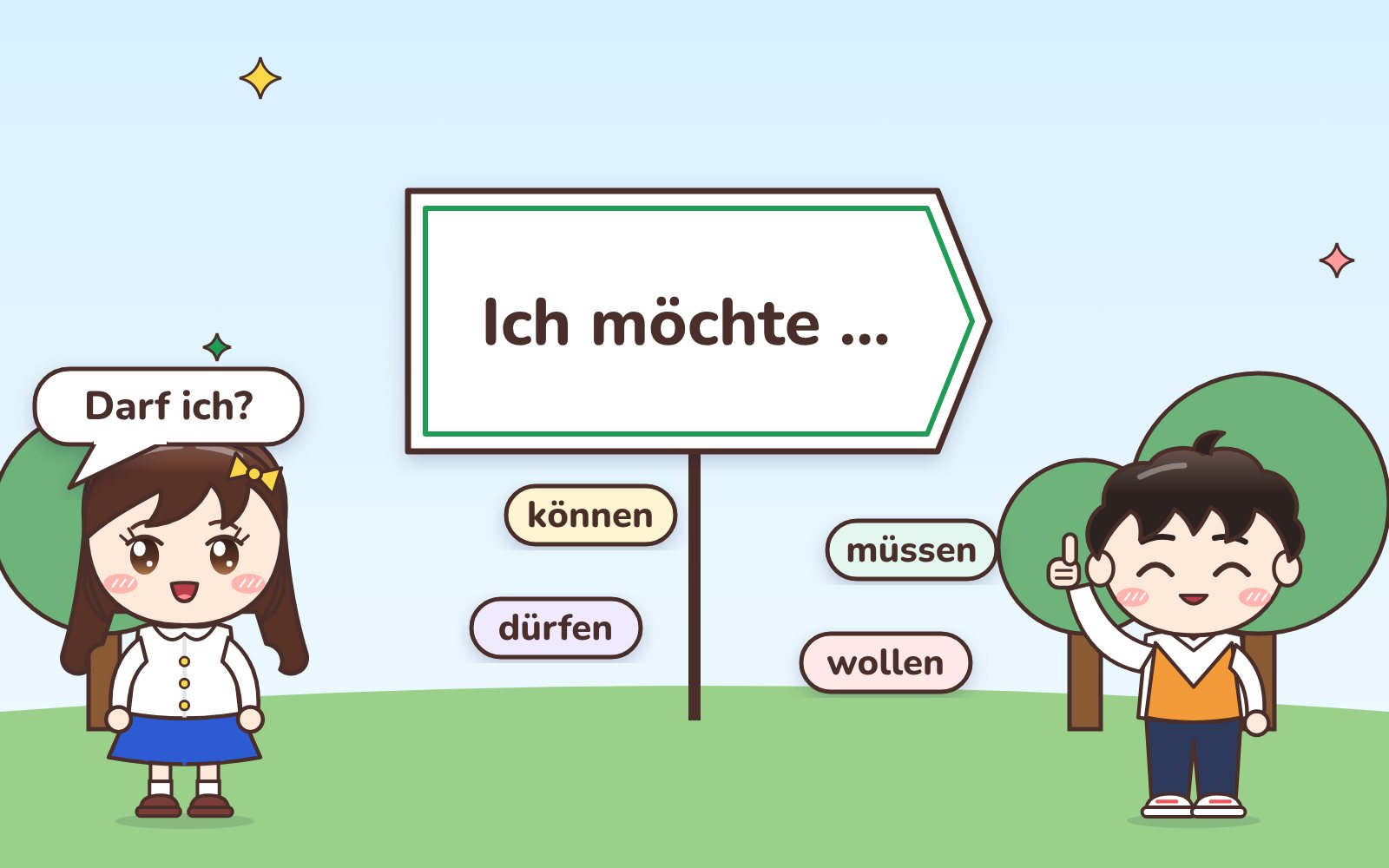
Modal verbs tell you how something is done: whether you can, must, may or want to do it. You need them from day one – "Ich möchte…", "Können Sie…?" – but learners stumble in three places: the irregular singular forms, the word order (the main verb jumps to the very end), and a false friend for English speakers: "Ich muss nicht" does not mean "I must not". Also note: "Ich will" means "I want", not "I will".
The six modal verbs
| Verb | Meaning | Example |
|---|---|---|
| können | can, be able to | Ich kann Deutsch sprechen. (I can speak German.) |
| müssen | must, have to | Ich muss arbeiten. (I have to work.) |
| dürfen | may, be allowed to | Darf ich hier sitzen? (May I sit here?) |
| sollen | should, be supposed to (someone else's advice or wish) | Der Arzt sagt, ich soll viel schlafen. (The doctor says I should sleep a lot.) |
| wollen | want to (a firm wish or plan) | Ich will Deutsch lernen. (I want to learn German.) |
| mögen | like (mostly with a noun) | Ich mag Kaffee. (I like coffee.) |
| möchten | would like (polite form of mögen) | Ich möchte bestellen. (I'd like to order.) |
Present tense forms
Two rules make the table easy: ich and er/sie/es have the same form, with no ending (ich kann, er kann – never "er kannt"), and most of the verbs change their vowel in the singular (können → kann, müssen → muss). The plural is regular.
| können | müssen | dürfen | sollen | wollen | mögen | möchten | |
|---|---|---|---|---|---|---|---|
| ich | kann | muss | darf | soll | will | mag | möchte |
| du | kannst | musst | darfst | sollst | willst | magst | möchtest |
| er/sie/es | kann | muss | darf | soll | will | mag | möchte |
| wir | können | müssen | dürfen | sollen | wollen | mögen | möchten |
| ihr | könnt | müsst | dürft | sollt | wollt | mögt | möchtet |
| sie/Sie | können | müssen | dürfen | sollen | wollen | mögen | möchten |
Word order: the infinitive goes to the end
The modal verb is conjugated and stands in position 2 (or at the start of a yes/no question). The second verb stays in the infinitive – without "zu" – and goes to the very end of the sentence. Everything else sits in between, like a bracket.
- Ich kann gut schwimmen. — I can swim well.
- Du musst heute lange arbeiten. — You have to work late today.
- Wir wollen am Samstag ins Kino gehen. — We want to go to the cinema on Saturday.
- Soll ich das Fenster öffnen? — Should I open the window?
- Morgen muss ich früh aufstehen. — Tomorrow I have to get up early.
Polite requests: Könnten Sie…? Ich möchte…
For requests, use Könnten Sie…? (Could you…?) – it is softer than "Können Sie…?". To say what you want, use Ich möchte… – "Ich will…" sounds blunt in a shop or office. Darf ich…? asks for permission. Note that möchte can also stand with a noun alone.
- Könnten Sie mir bitte helfen? — Could you help me, please?
- Könnten Sie das bitte wiederholen? — Could you repeat that, please?
- Darf ich hier sitzen? — May I sit here?
- Ich möchte einen Kaffee, bitte. — I'd like a coffee, please.
- Ich möchte einen Termin machen. — I'd like to make an appointment.
The trap: nicht müssen vs. nicht dürfen
nicht müssen = there is no obligation – you don't have to. nicht dürfen = it is forbidden – you must not. English speakers are caught out because "must not" looks like "muss nicht", but it means "darf nicht".
| German | Meaning |
|---|---|
| Du musst nicht kommen. | You don't have to come (you can if you want). |
| Du darfst nicht kommen. | You must not come (it's not allowed). |
- Du musst nicht kommen. — You don't have to come.
- Du darfst nicht kommen. — You're not allowed to come.
- Am Sonntag muss ich nicht arbeiten. — I don't have to work on Sunday.
- Hier darf man nicht parken. — You must not park here.
Common mistakes
- ✗ Ich kann schwimmen gut. → ✓ Ich kann gut schwimmen. — The infinitive goes to the very end.
- ✗ Er kannt gut kochen. → ✓ Er kann gut kochen. — No ending for er/sie/es.
- ✗ Hier muss man nicht rauchen. (meaning "smoking is forbidden") → ✓ Hier darf man nicht rauchen. — Forbidden = nicht dürfen.
Quick check
- Fill in müssen: Sie (she) ___ heute einkaufen.
Answer
Sie muss heute einkaufen. – she has to go shopping today.- Put in order: ich / Deutsch / will / lernen
Answer
Ich will Deutsch lernen. – the infinitive "lernen" goes to the end.- "You must not take photos here." – muss nicht or darf nicht?