German lessons · German grammar · A2
am Montag, um 8 Uhr, im November: German time prepositions in one place
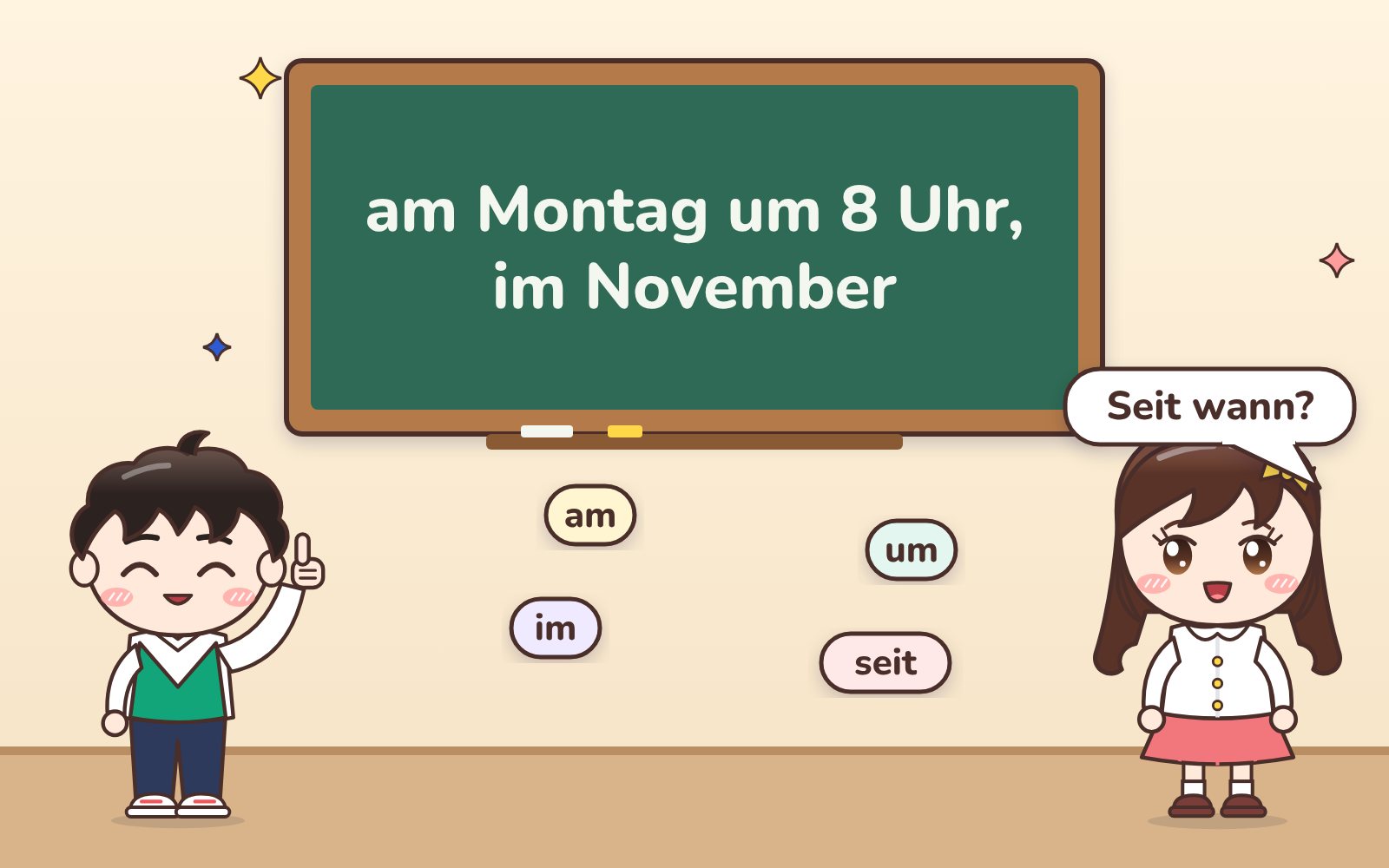
When you book a doctor's appointment in Germany or arrange to meet a friend, time prepositions are the words you use most. Der Termin ist am Montag um 8 Uhr. (The appointment is on Monday at 8.) English switches between "on", "at" and "in", and German does too, just with its own system: am for days, um for clock times, im for months and seasons. Once you know the rules, it's simpler than it looks.
am, um, im: when?
| Preposition | Used with | Examples |
|---|---|---|
| am (an + dem) | days, dates, parts of the day, the weekend | am Montag, am 5. November, am Abend, am Wochenende |
| um | clock times | um 8 Uhr, um halb neun, um Mitternacht |
| im (in + dem) | months, seasons | im November, im Winter, im Sommer |
| in der | night | in der Nacht |
- Wir treffen uns am Samstag. — We're meeting on Saturday.
- Der Kurs beginnt um 18 Uhr. — The course starts at 6 pm.
- Im Winter wird es früh dunkel. — In winter it gets dark early.
- In der Nacht ist es sehr kalt. — It's very cold at night.
Night is the exception. It's am Morgen and am Abend, but not am Nacht — it's in der Nacht. Years take no preposition: 2026 or im Jahr 2026 (never "in 2026" as in English). For "around 8", not an exact time, use gegen 8 Uhr.
seit and vor: "since/for" and "ago"
Both take the dative, but they mean completely different things.
- seit — something that started in the past and is still going on. The verb is in the present tense (where English uses "have been …ing").
- vor — one point in the past, "… ago". The verb is usually in the simple past or the present perfect.
| Examples | Meaning | |
|---|---|---|
| seit | seit einem Jahr, seit drei Wochen, seit Montag | for a year (until now), for three weeks, since Monday |
| vor | vor einem Jahr, vor drei Wochen | a year ago, three weeks ago |
- Ich wohne seit zwei Jahren in Berlin. — I've been living in Berlin for two years. (and still do)
- Ich bin vor zwei Jahren nach Berlin gekommen. — I came to Berlin two years ago.
- Seit wann lernen Sie Deutsch? — How long have you been learning German?
ab, bis, von … bis: start and end
- ab — "from … (on)". You'll see it a lot with new rules and opening hours: ab Montag, ab 1. Dezember, ab nächster Woche
- bis — "until/by". Without an article it's simply bis Freitag, bis 18 Uhr; with an article it's bis zum 5. November
-
von … bis — "from … to/until": von 9 bis 17 Uhr, vom 1. bis zum 5. Mai
-
Die Praxis ist von 8 bis 12 Uhr geöffnet. — The practice is open from 8 to 12.
- Ab Dezember kann man sich online anmelden. — From December you can register your address online.
- Bis morgen! — See you tomorrow!
in and nach: "in … time" and "after"
For something in the future, "in … (from now)" is in + dative. "After" an event is nach + dative.
- Der Bus kommt in zehn Minuten. — The bus is coming in ten minutes.
- Nach dem Essen gehen wir spazieren. — After the meal we're going for a walk.
Common mistakes
- ❌ Ich habe seit zwei Jahren in Berlin gewohnt. (when you still live there) → ✅ Ich wohne seit zwei Jahren in Berlin.
- ❌ Ich bin seit drei Jahren nach Deutschland gekommen. → ✅ Ich bin vor drei Jahren nach Deutschland gekommen. (a one-off event takes vor)
- ❌ im Montag, am Nacht, im 2026 → ✅ am Montag, in der Nacht, 2026 / im Jahr 2026
Quick check
- Fill the gaps: Der Termin ist ___ Freitag ___ 10 Uhr.
Answer
am, um — Der Termin ist am Freitag um 10 Uhr.- Which sentence is correct? (a) Ich lerne seit einem Jahr Deutsch. (b) Ich lerne vor einem Jahr Deutsch.
Answer
(a) — you're still learning, so it's seit + present tense.- How do you say "from December" in German? ___ Dezember gilt die neue Regel.