German lessons · German grammar · A1
Nominative vs. Accusative
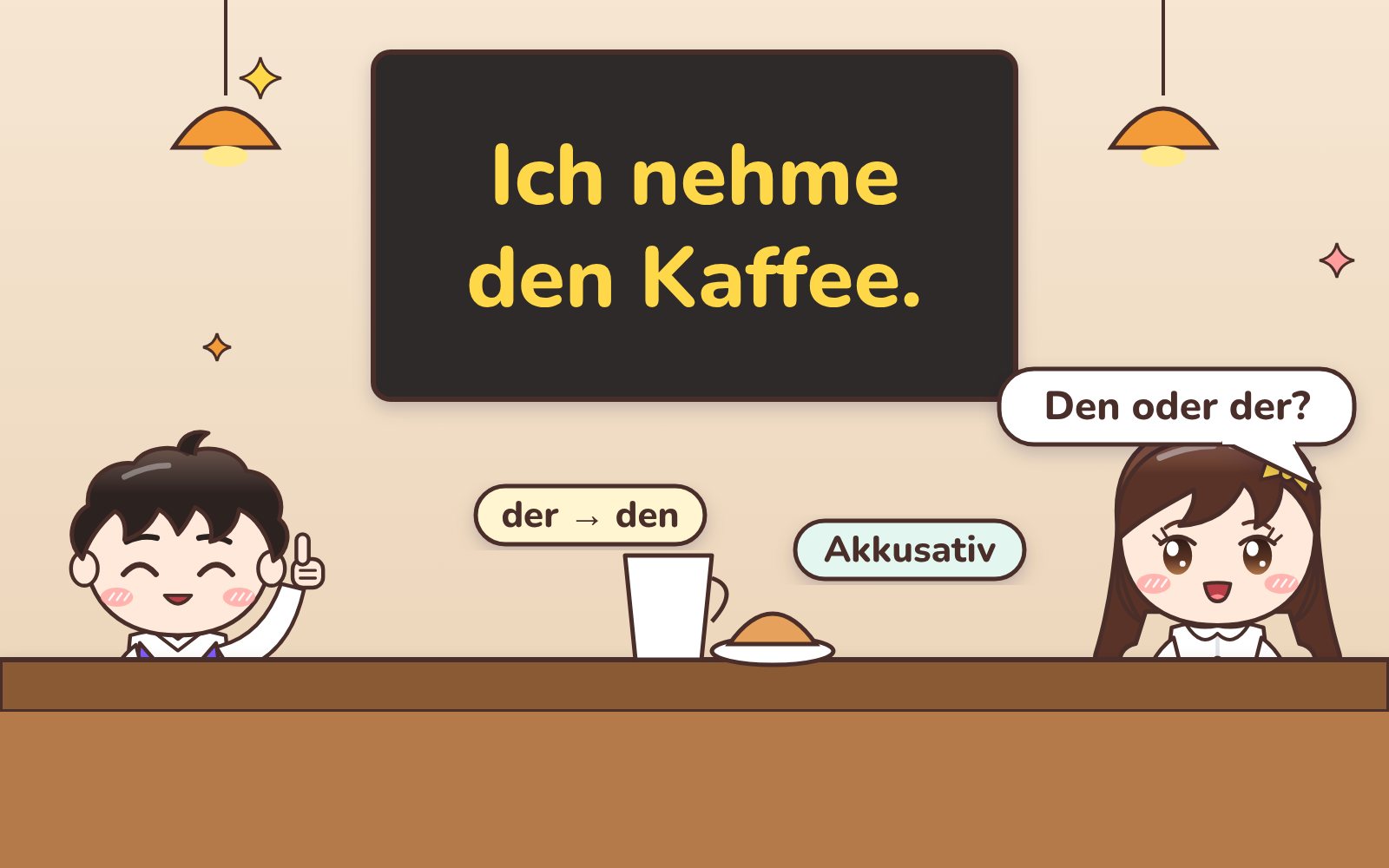
German marks who does an action (the subject, nominative) and who or what receives it (the direct object, accusative). English does this only with word order and a few pronouns (he → him), so learners often forget it. The good news: in the accusative, only the masculine article changes. Feminine, neuter and plural stay exactly the same.
The rule: only the masculine changes
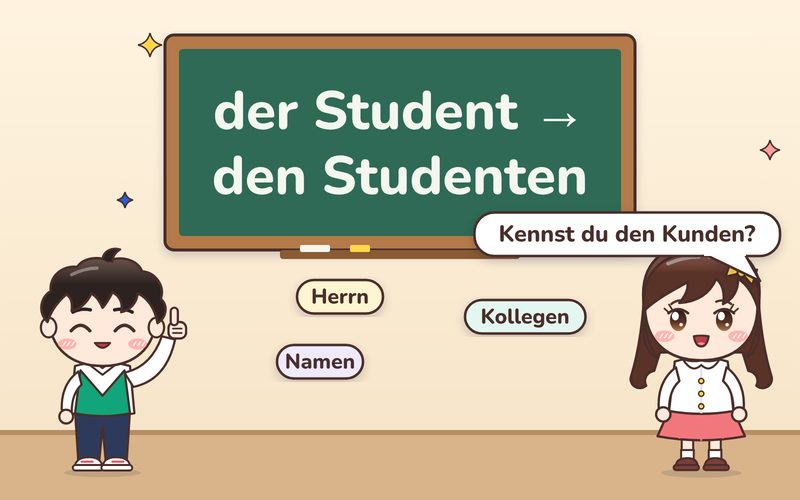
The subject answers "who?" (wer?), the direct object answers "whom / what?" (wen? was?). If the object is a masculine noun, der becomes den, ein becomes einen, kein becomes keinen. The noun itself normally stays the same.
| masculine | feminine | neuter | plural | |
|---|---|---|---|---|
| Nominative | der / ein / kein | die / eine / keine | das / ein / kein | die / – / keine |
| Accusative | den / einen / keinen | die / eine / keine | das / ein / kein | die / – / keine |
- Der Hund sieht den Mann. — The dog sees the man.
- Den Mann sieht der Hund. — The dog sees the man. (The word order changed, the meaning did not: den shows the object.)
- Ich habe einen Bruder und eine Schwester. — I have a brother and a sister.
- Wir kaufen das Auto. — We are buying the car.
- Er hat keinen Hunger. — He isn't hungry. (literally: he has no hunger)
Common verbs with the accusative
Most everyday verbs take a direct object in the accusative: haben, brauchen, kaufen, sehen, nehmen, trinken, kennen — and the phrase es gibt ("there is / there are"). Careful: sein ("to be") is different — after sein both sides are nominative: Das ist ein Tisch.
- Ich brauche einen Termin. — I need an appointment.
- Sie kauft einen Tisch und eine Lampe. — She is buying a table and a lamp.
- Siehst du den Bus? — Do you see the bus?
- Es gibt einen Supermarkt in der Nähe. — There is a supermarket nearby.
- Hast du einen Stift? — Do you have a pen?
Personal pronouns: ich → mich, er → ihn
Pronouns change too. Only sie, es and Sie look the same in both cases. Ihn is used for every masculine noun — people and things.
| Nominative | ich | du | er | sie | es | wir | ihr | sie / Sie |
|---|---|---|---|---|---|---|---|---|
| Accusative | mich | dich | ihn | sie | es | uns | euch | sie / Sie |
- Ich sehe dich. — I see you.
- Kennst du ihn? — Do you know him?
- Der Kaffee? Ich trinke ihn ohne Zucker. — The coffee? I drink it without sugar.
- Wir besuchen euch morgen. — We'll visit you (all) tomorrow.
Common mistakes
- ✗ Ich habe ein Bruder. → ✓ Ich habe einen Bruder. (der Bruder is masculine)
- ✗ Das ist einen Tisch. → ✓ Das ist ein Tisch. (sein takes the nominative)
- ✗ Ich sehe er. → ✓ Ich sehe ihn.
Quick check
- Ich brauche ___ Laptop. (der Laptop, "a")
Answer
einen — Ich brauche einen Laptop.- Ich kenne ___ nicht. (er)
Answer
ihn — Ich kenne ihn nicht.- Das ist der Lehrer or Das ist den Lehrer?