German lessons · German grammar · A1
mich or mir? How personal pronouns change in each case
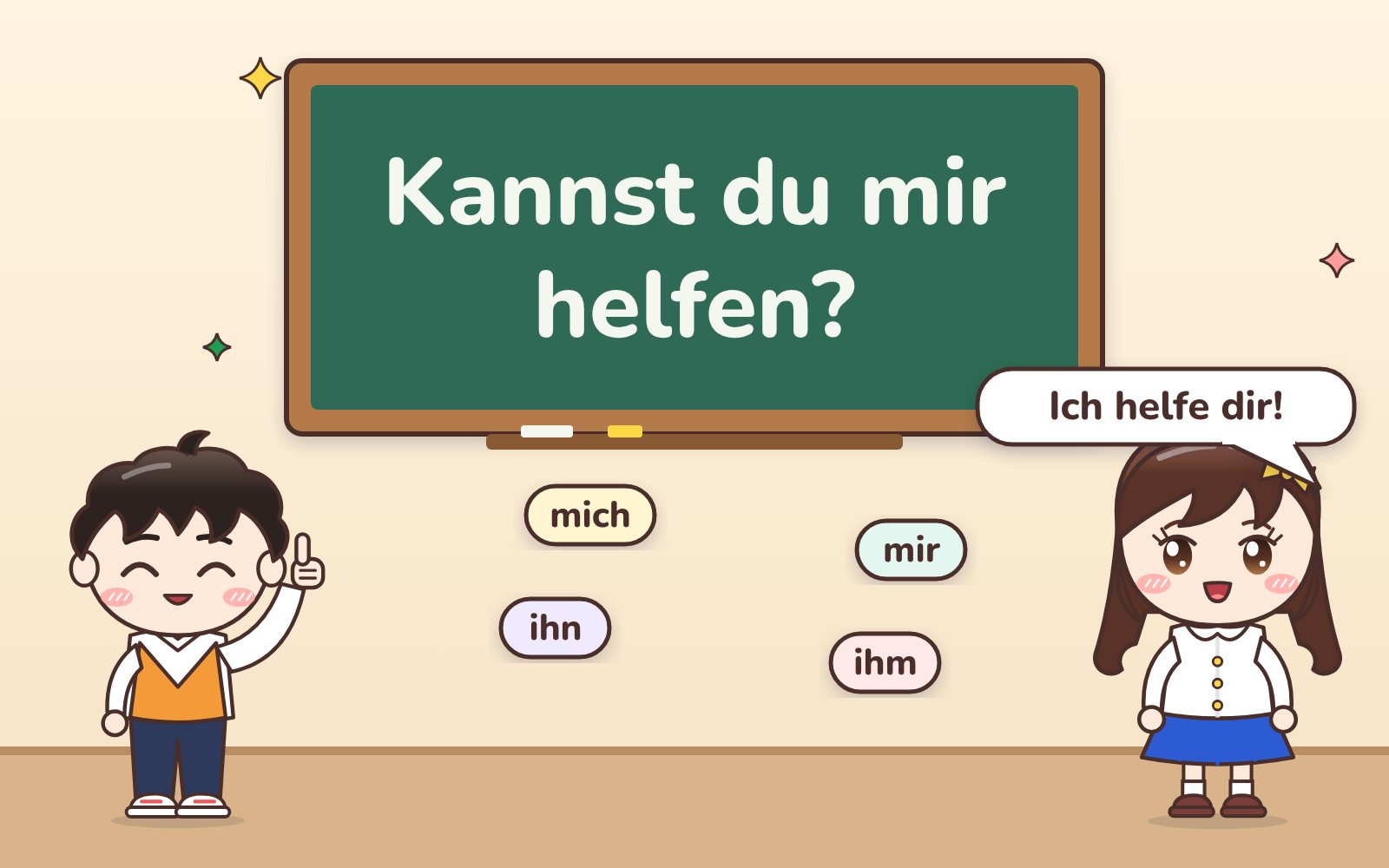
Sooner or later every learner wonders whether it's "Kannst du mir helfen?" or "Kannst du mich helfen?" English does something similar with I → me and he → him, but German goes one step further: it has a separate form for the dative too, so ich becomes mich or mir depending on its role. The good news: all the personal pronouns fit into a single table. Once you know it, half of the sentences you use every day get much easier.
The whole table at a glance
| Nominative (who) | Accusative (whom) | Dative (to whom) |
|---|---|---|
| ich | mich | mir |
| du | dich | dir |
| er | ihn | ihm |
| sie (she) | sie | ihr |
| es | es | ihm |
| wir | uns | uns |
| ihr (you, plural) | euch | euch |
| sie (they) | sie | ihnen |
| Sie (you, polite) | Sie | Ihnen |
Here's a trick: for ich and du, the accusative ends in -ch (mich, dich) and the dative ends in -r (mir, dir). er → ihn (accusative) has the -n of the article den, and er → ihm (dative) has the -m of dem. For wir and ihr, the accusative and dative are the same (uns, euch), so there's nothing to decide.
- Ich sehe dich morgen. — I'll see you tomorrow.
- Kannst du mir helfen? — Can you help me?
- Wir besuchen euch am Wochenende. — We'll come and visit you at the weekend.
- Wie geht es Ihnen? — How are you?
Things are er, sie and es too
In German, things have a gender, so the pronoun follows that gender. der Kaffee is masculine, so it's er/ihn; die Tasche is feminine, so it's sie; das Handy is neuter, so it's es. In English all of them are just "it", but in German you have to look at the article to choose.
- Der Kaffee ist gut. Ich trinke ihn ohne Zucker. — The coffee is good. I drink it without sugar.
- Wo ist die Tasche? – Sie liegt im Auto. — Where's the bag? – It's in the car.
- Das Handy? Ich habe es zu Hause vergessen. — My phone? I left it at home.
Verbs that take the dative: helfen, danken, gefallen …
Most verbs take an accusative object (Ich frage dich). But a few very common verbs want the dative. In English they look like they have a normal direct object ("help me", "thank you"), which is why they cause so many mistakes.
| Verb | Example |
|---|---|
| helfen to help | Ich helfe dir. — I'll help you. |
| danken to thank | Ich danke Ihnen. — Thank you. |
| gefallen to be liked by | Die Wohnung gefällt mir. — I like the flat. |
| gehören to belong to | Das Fahrrad gehört ihm. — The bike is his. |
| antworten to answer | Bitte antworten Sie mir bis Freitag. — Please reply to me by Friday. |
Prepositions decide the case too. mit, bei, nach, von, zu take the dative (mit mir, bei uns), and für, ohne, gegen take the accusative (für dich, ohne ihn).
The order of two pronouns
When two pronouns come together, as in "give it to him", the accusative comes first and the dative second. That's the opposite of the order with nouns (Ich gebe dem Mann das Buch), so take care.
- Ich gebe dem Mann das Buch. — I'm giving the man the book. (two nouns: dative → accusative)
- Ich gebe ihm das Buch. — I'm giving him the book. (the pronoun comes before the noun)
- Ich gebe es ihm. — I'm giving it to him. (two pronouns: accusative → dative)
- Kannst du es mir zeigen? — Can you show it to me?
Common mistakes
- ❌ Kannst du mich helfen? → ✅ Kannst du mir helfen? (helfen takes the dative)
- ❌ Das gefällt mich. → ✅ Das gefällt mir. (the person who likes it is in the dative)
- ❌ Ich gebe ihm es. → ✅ Ich gebe es ihm. (with two pronouns, the accusative comes first)
Quick check
- Fill the gap: Wie geht es ___? (polite)
Answer
Ihnen — "Wie geht es Ihnen?" It's the dative of the polite Sie.- Der Pullover ist schön. Ich kaufe ___.
Answer
ihn — der Pullover is masculine, and the object of kaufen is in the accusative, so it's ihn.- Which sentence has the right order? (a) Ich schicke dir sie. (b) Ich schicke sie dir.