German lessons · German grammar · A2
Reflexive Verbs (sich freuen, sich erinnern)
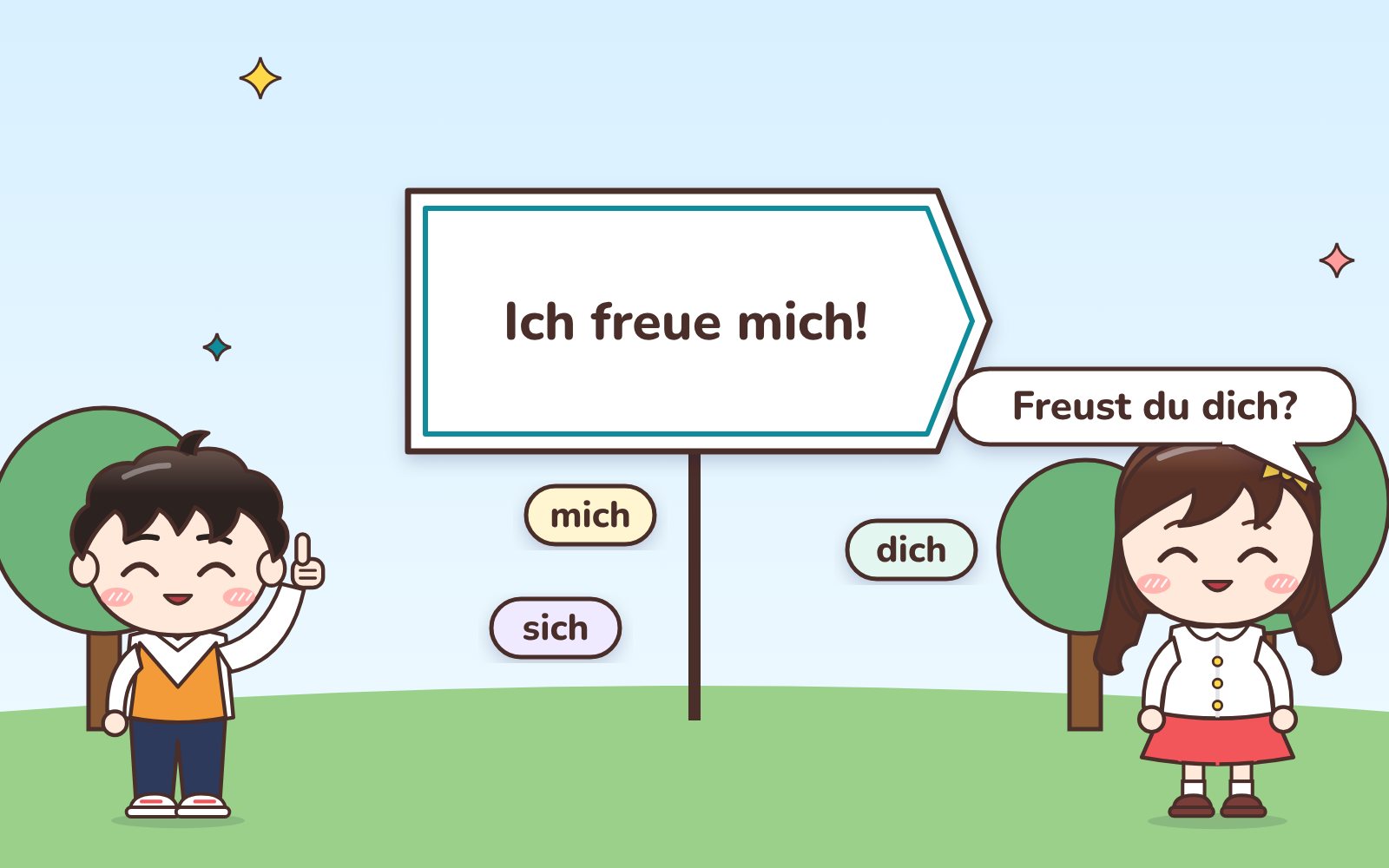
Many everyday German verbs come with a small extra word: sich. You don't just "look forward" – you look forward yourself: Ich freue mich. English rarely does this, so learners often drop the pronoun, choose mich when it should be mir, or put it in the wrong place. Here are the few rules you need.
Reflexive pronouns
A reflexive pronoun points back to the subject. It changes with the person. Most of the time it is in the accusative; only ich and du have a different dative form.
| Person | Accusative | Dative |
|---|---|---|
| ich | mich | mir |
| du | dich | dir |
| er / sie / es | sich | sich |
| wir | uns | uns |
| ihr | euch | euch |
| sie / Sie | sich | sich |
- Ich freue mich auf das Wochenende. — I'm looking forward to the weekend.
- Freust du dich auf die Ferien? — Are you looking forward to the holidays?
- Wir interessieren uns für Fußball. — We're interested in football.
- Erinnert ihr euch an den Lehrer? — Do you remember the teacher?
Reflexive in German, not in English
In English these are ordinary verbs or adjectives ("to hurry", "to remember", "to be interested"). In German you must add the pronoun. Learn each verb together with sich and its preposition.
| German | Preposition | English |
|---|---|---|
| sich freuen | auf + Acc. (something coming) | to look forward to |
| sich freuen | über + Acc. (something you got / that happened) | to be happy about |
| sich interessieren | für + Acc. | to be interested in |
| sich erinnern | an + Acc. | to remember |
| sich anmelden | für + Acc. / zu + Dat. | to register, sign up |
| sich beeilen | – | to hurry |
| sich vorstellen | – | to introduce oneself |
- Beeil dich, der Bus kommt! — Hurry up, the bus is coming!
- Sie freut sich über das Geschenk. — She's happy about the present.
- Ich erinnere mich gut an meine Schulzeit. — I remember my school days well.
- Hast du dich schon für den Kurs angemeldet? — Have you already signed up for the course?
- Interessieren Sie sich für Kunst? — Are you interested in art?
Accusative or dative: mich or mir?
Use the accusative (mich, dich) when there is no other object. Use the dative (mir, dir) when the sentence already has an accusative object. Sich vorstellen even changes its meaning: mich vorstellen = introduce myself, mir etwas vorstellen = imagine something.
| Verb | Accusative (no other object) | Dative (+ accusative object) |
|---|---|---|
| sich vorstellen | Ich stelle mich vor. | Ich stelle mir das vor. |
| sich waschen | Ich wasche mich. | Ich wasche mir die Hände. |
| sich anziehen | Du ziehst dich an. | Du ziehst dir eine Jacke an. |
- Darf ich mich vorstellen? Ich heiße Lena. — May I introduce myself? My name is Lena.
- Ich kann mir das nicht vorstellen. — I can't imagine that.
- Ich wasche mir die Hände. — I'm washing my hands.
- Stell dir vor, ich habe die Prüfung bestanden! — Imagine, I passed the exam!
Word order
The reflexive pronoun goes right after the conjugated verb (or right after a pronoun subject). In subordinate clauses it comes early, before the verb at the end. In the Perfekt, reflexive verbs always use haben.
| Sentence type | Example |
|---|---|
| Main clause | Ich freue mich auf den Urlaub. |
| Something else first | Morgen melde ich mich an. |
| With a modal verb | Wir müssen uns beeilen. |
| Perfekt | Er hat sich beeilt. |
| Subordinate clause | …, weil ich mich für Kunst interessiere. |
- Heute freut sich mein Sohn über das Paket. — Today my son is happy about the parcel.
- Ich muss mich noch anmelden. — I still have to register.
- Wir haben uns gestern vorgestellt. — We introduced ourselves yesterday.
- Ich weiß nicht, ob er sich an mich erinnert. — I don't know if he remembers me.
Common mistakes
- ✗ Ich freue auf den Urlaub. → ✓ Ich freue mich auf den Urlaub. (the pronoun is not optional)
- ✗ Ich kann mich das nicht vorstellen. → ✓ Ich kann mir das nicht vorstellen. (das is the accusative object, so mir)
- ✗ Ich bin mich beeilt. → ✓ Ich habe mich beeilt. (reflexive verbs take haben)
Quick check
- Wir freuen ___ auf die Party.
Answer
uns – Wir freuen uns auf die Party.- Ich ziehe ___ eine Jacke an. (mich or mir?)
Answer
mir – *eine Jacke* is already the accusative object.- Put into the Perfekt: Er beeilt sich.