German lessons · German grammar · B1
Der Mann, der …: relative clauses in German
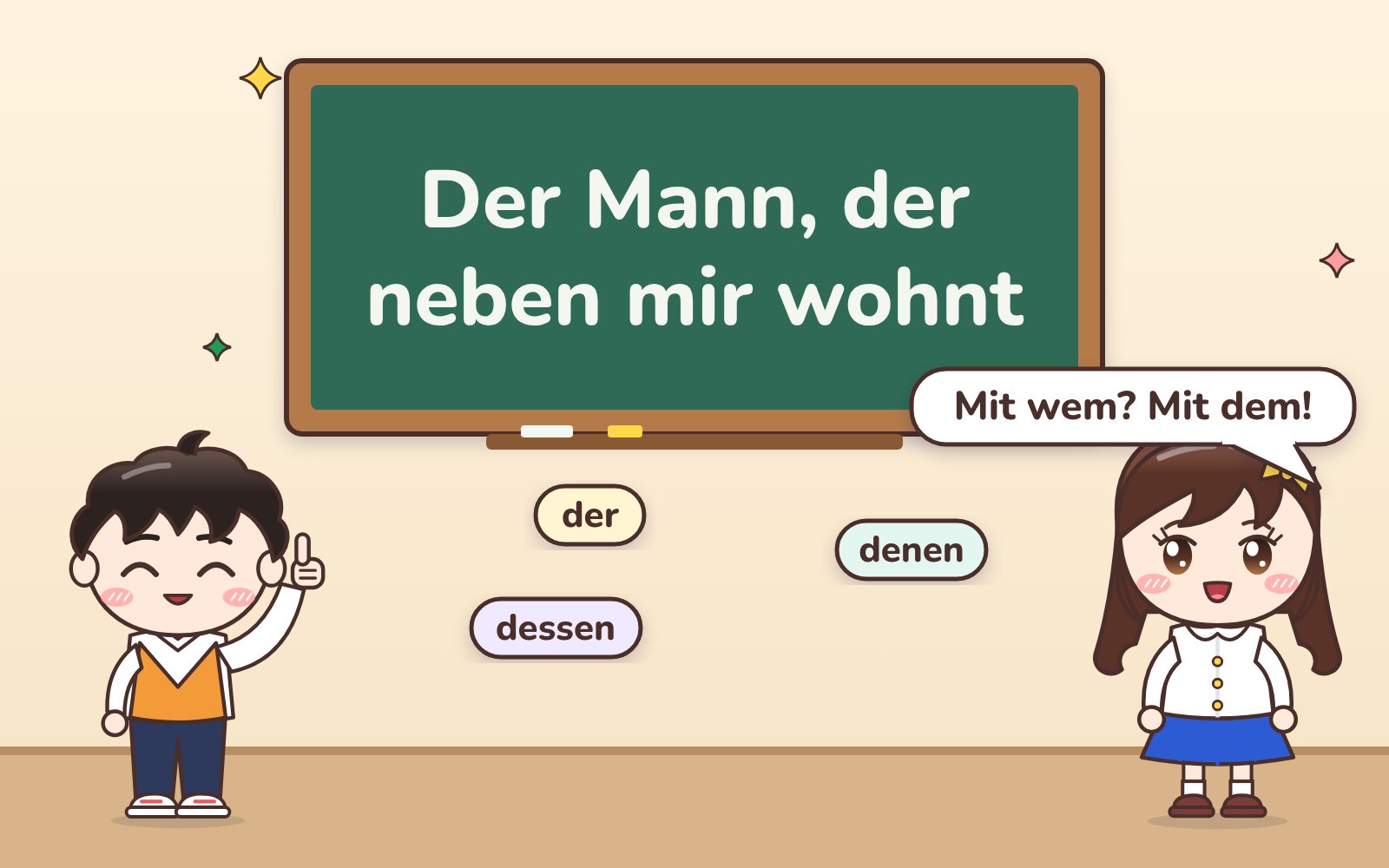
"The man who lives next door", "the book I bought yesterday", "the friend I study German with" — when you want to say more about a noun, German adds a small extra sentence after it, separated by a comma. This is a relative clause (Relativsatz). You'll meet it all the time in B1 reading and writing tasks and in everyday conversation. It looks hard at first, but there are only three rules: choose the right relative pronoun, use commas, and put the verb at the end.
The basic shape: comma + relative pronoun + … + verb
- Das ist der Mann, der neben mir wohnt. — That's the man who lives next door to me.
- Ich suche eine Wohnung, die nicht so teuer ist. — I'm looking for a flat that isn't too expensive.
- Das Buch, das ich gestern gekauft habe, ist sehr spannend. — The book I bought yesterday is really gripping.
Inside a relative clause the verb goes to the end (just as after weil and dass). In the perfect tense the auxiliary comes last: gekauft habe. And a relative clause is always set off by commas — two of them if it sits in the middle of the sentence.
The relative pronoun table
Two things decide the pronoun: gender and number come from the noun it refers to, the case comes from its role inside the relative clause. Most forms are the same as the definite article — only the five in bold are different.
| Case | Masculine (der Mann) | Feminine (die Frau) | Neuter (das Kind) | Plural (die Leute) |
|---|---|---|---|---|
| Nominative | der | die | das | die |
| Accusative | den | die | das | die |
| Dative | dem | der | dem | denen |
| Genitive | dessen | deren | dessen | deren |
- Der Kollege, den ich gestern getroffen habe, kommt aus Köln. — The colleague I met yesterday is from Cologne. (treffen + accusative → den)
- Die Nachbarin, der ich geholfen habe, hat mir Kuchen gebracht. — The neighbour I helped brought me some cake. (helfen + dative → der)
- Die Freunde, denen ich das Foto geschickt habe, finden es toll. — The friends I sent the photo to love it. (plural dative → denen)
- Das ist der Nachbar, dessen Hund immer bellt. — That's the neighbour whose dog is always barking. (whose → dessen)
How to find the case
Split it into two sentences: Der Kollege kommt aus Köln. Ich habe den Kollegen gestern getroffen. In the second sentence the noun is accusative, so the relative pronoun is accusative too: den. The gender (masculine) comes from der Kollege, the case (accusative) from treffen. It doesn't matter that the noun is nominative in the main clause — only its role inside the relative clause counts.
With a preposition: mit der, für den, in der
If the verb or phrase needs a preposition, put it right before the relative pronoun. The preposition decides the case.
- Das ist die Frau, mit der ich Deutsch lerne. — That's the woman I study German with. (mit + dative)
- Der Kurs, für den ich mich angemeldet habe, beginnt im Januar. — The course I signed up for starts in January. (für + accusative)
- Berlin ist eine Stadt, in der Menschen aus aller Welt leben. — Berlin is a city where people from all over the world live. (in + dative, place)
The preposition never goes to the end of the clause. German has no "the woman I study with" — it's always mit der.
was and wo
After alles, etwas, nichts, vieles, das use was. After places you can often use wo instead of in der/in dem.
- Alles, was du brauchst, steht auf der Liste. — Everything you need is on the list.
- Das ist etwas, was ich nicht verstehe. — That's something I don't understand.
- Das ist das Café, wo wir uns kennengelernt haben. — That's the café where we met.
Common mistakes
- ❌ Der Mann, der ich kenne, … → ✅ Der Mann, den ich kenne, … (ich is the subject; the man is the object of kennen, so accusative.)
- ❌ Das Buch, das ich gestern habe gekauft, … → ✅ Das Buch, das ich gestern gekauft habe, … (the auxiliary goes last.)
- ❌ Die Kinder, die ich Geschenke gebe, … → ✅ Die Kinder, denen ich Geschenke gebe, … (plural dative is denen.)
- ❌ Das ist alles, das ich weiß. → ✅ Das ist alles, was ich weiß. (after alles: was.)
Quick check
- Fill the gap: Die Wohnung, ___ ich gemietet habe, ist klein.
Answer
die — die Wohnung is feminine and the object of mieten (accusative), so die.- Fill the gap: Das ist der Lehrer, ___ ich die E-Mail geschrieben habe. (I wrote the e-mail to him.)
Answer
dem — jemandem schreiben takes the dative; masculine dative is dem.- Join into one sentence: Ich wohne in einer Stadt. Die Stadt ist sehr grün.