German lessons · German grammar · B1
Subordinate clauses: weil, dass, wenn, ob, obwohl, als
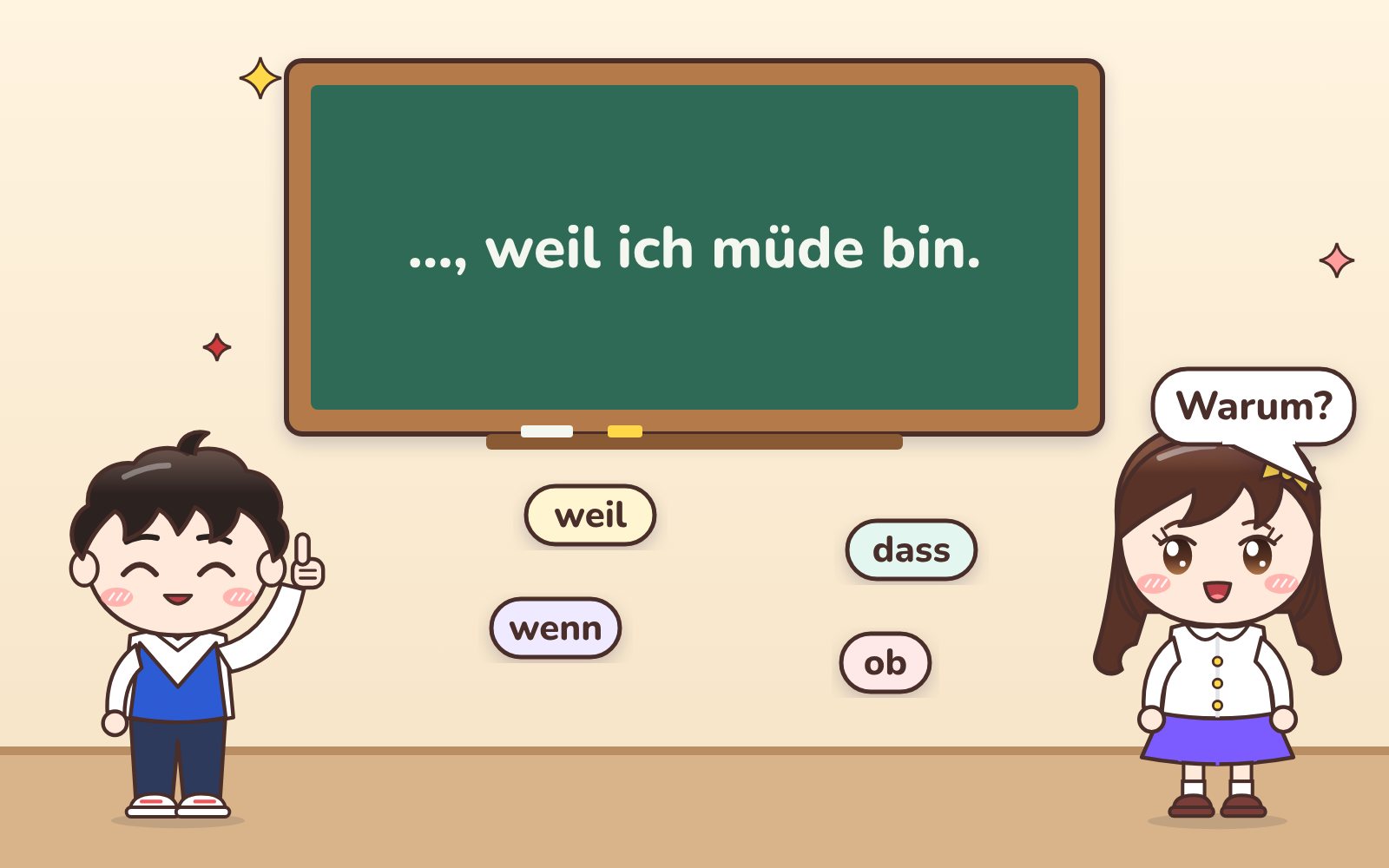
Words like weil (because) or dass (that) start a subordinate clause (Nebensatz) – a clause that cannot stand on its own. The big change: the conjugated verb moves to the very end. Learners usually know this rule but forget it while speaking, especially with modal verbs and the perfect tense. And once the subordinate clause comes first, the main clause has to change too.
The verb goes to the end
In a subordinate clause the conjugated verb (the one with the ending) is the last word. Separable verbs join back together, and modal verbs or haben/sein stand after the infinitive or participle. There is always a comma between main clause and subordinate clause.
| Conjunction | Meaning | Example clause |
|---|---|---|
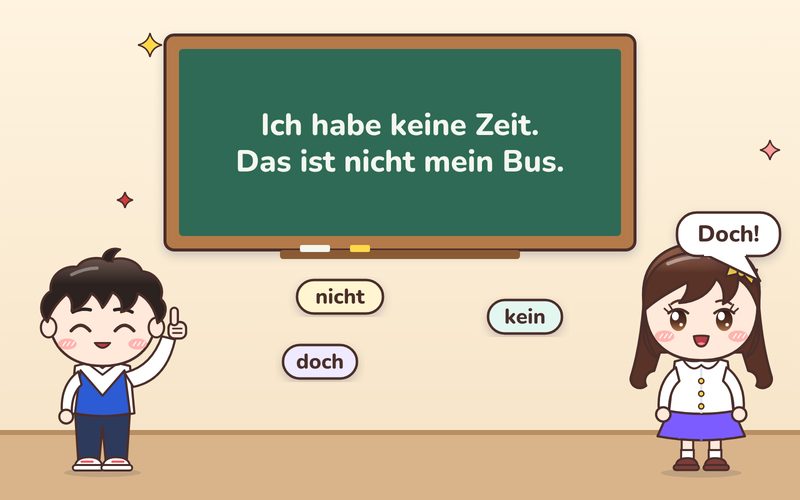
| weil | because | …, weil ich keine Zeit habe. |
| dass | that | …, dass der Zug um 8 Uhr ankommt. |
| wenn | if / when (every time) | …, wenn ich nach Hause komme. |
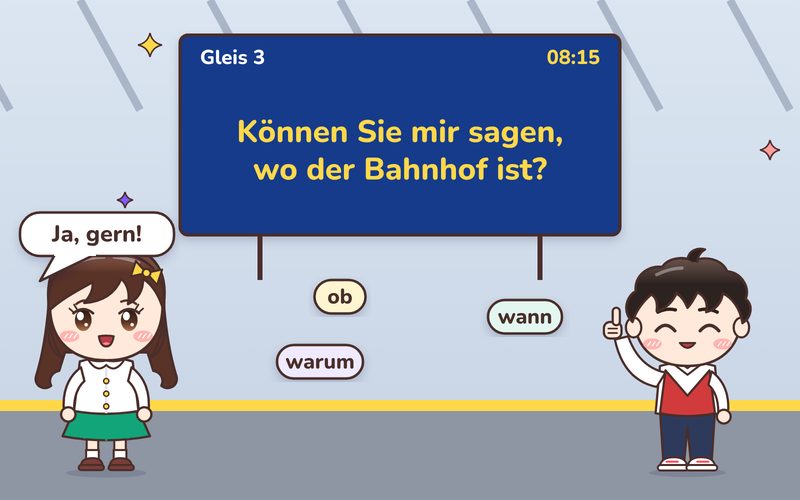
| ob | whether / if | …, ob er morgen kommen kann. |
| obwohl | although | …, obwohl ich krank bin. |
| als | when (once, in the past) | …, als ich ein Kind war. |
- Ich lerne Deutsch, weil ich in Deutschland arbeite. — I'm learning German because I work in Germany.
- Ich glaube, dass der Zug um 8 Uhr ankommt. — I think (that) the train arrives at 8.
- Weißt du, ob die Apotheke heute geöffnet ist? — Do you know whether the pharmacy is open today?
- Er sagt, dass er morgen nicht kommen kann. — He says he can't come tomorrow.
- Ich gehe zur Arbeit, obwohl ich krank bin. — I'm going to work although I'm ill.
Subordinate clause first: the main clause starts with the verb
German main clauses keep the verb in position 2. If the whole subordinate clause comes first, it fills position 1 – so the main clause continues directly with the verb, then the subject. You get the pattern "verb, comma, verb".
| Position 1 | Position 2 (verb) | Rest |
|---|---|---|
| Ich | komme, | wenn ich Zeit habe. |
| Wenn ich Zeit habe, | komme | ich. |
- Wenn ich Zeit habe, komme ich. — If I have time, I'll come.
- Weil der Bus nicht kommt, nehme ich ein Taxi. — Because the bus isn't coming, I'll take a taxi.
- Obwohl es regnet, gehen wir spazieren. — Although it's raining, we're going for a walk.
- Als ich ein Kind war, habe ich auf dem Land gewohnt. — When I was a child, I lived in the countryside.
weil vs. denn, wenn vs. als
weil and denn both mean "because", but only weil sends the verb to the end; after denn the word order stays normal, and a denn clause can never come first. als is for one event or one period in the past; wenn is for the present and future, and for things that happened again and again in the past ("whenever").
| Word | Word order | Use |
|---|---|---|
| weil | verb at the end | because |
| denn | normal (verb in position 2) | because – only after the main clause |
| als | verb at the end | one time / one period in the past |
| wenn | verb at the end | present, future, repeated events |
- Ich bleibe heute zu Hause, weil ich müde bin. — I'm staying home today because I'm tired.
- Ich bleibe heute zu Hause, denn ich bin müde. — I'm staying home today, because I'm tired.
- Als ich nach Deutschland gekommen bin, konnte ich kein Deutsch. — When I came to Germany, I couldn't speak any German.
- Immer wenn ich meine Oma besucht habe, hat sie Kuchen gebacken. — Whenever I visited my grandma, she baked a cake.
- Wenn ich nach Hause komme, rufe ich dich an. — When I get home, I'll call you.
Common mistakes
- Ich lerne Deutsch, weil ich will in Deutschland arbeiten. → Ich lerne Deutsch, weil ich in Deutschland arbeiten will. — the modal verb goes to the very end.
- Wenn ich Zeit habe, ich komme. → Wenn ich Zeit habe, komme ich. — after a subordinate clause the verb comes first.
- Wenn ich ein Kind war, habe ich auf dem Land gewohnt. → Als ich ein Kind war, habe ich auf dem Land gewohnt. — childhood is one period in the past, so als.
Quick check
- Join with weil: Ich komme nicht. Ich habe keine Zeit.
Answer
Ich komme nicht, weil ich keine Zeit habe.- als or wenn? ___ ich gestern nach Hause kam, war niemand da.
Answer
Als – it happened once, yesterday.- Fix the word order: Obwohl ich müde bin, ich gehe ins Kino.