German lessons · German exam guides · A2–B1
DTZ speaking test: how to prepare, from introducing yourself to planning together
At the end of the integration course (Integrationskurs) you take the DTZ (Deutsch-Test für Zuwanderer). In this test speaking (Sprechen) is especially important: if you don't reach the level in speaking, you can't get the overall B1 or A2. The good news: the speaking test always follows the same order. Know the order, get a few sentences ready, and you'll be far less nervous. The structure of the whole test is in our guide to the DTZ and the integration course.
What the speaking test looks like
You take the speaking test in pairs, for about 15 minutes. In front of the examiners you talk in turns and together with your partner. The official practice sets (Modellsatz, Übungssatz) show three parts:
| Part | What you do | Key points |
|---|---|---|
| Teil 1 | Sich vorstellen — introducing yourself | Name, origin, where you live, family, work or school, learning German. The examiner asks a few more questions |
| Teil 2 | Über Erfahrungen sprechen — a photo + your experience | You say what you see in a photo, then talk about your own experience with the topic |
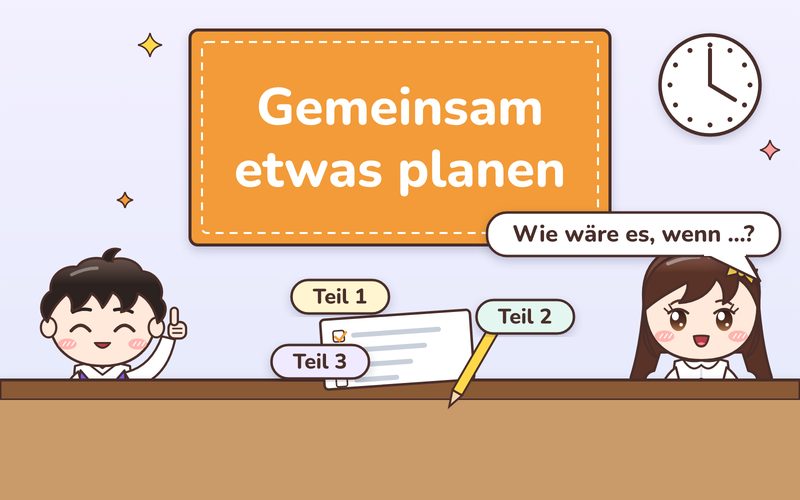
| Teil 3 | Gemeinsam etwas planen — planning something together | With your partner you follow the points on the task sheet (when, where, what …): suggest, react and decide together |
- Assessment — the examiners use fixed criteria: how well you complete the task, how fluently you speak, vocabulary and grammar, pronunciation. Completing the task matters more than talking a lot on your own
- A pair exam — especially in Teil 3, reacting to your partner is part of the task. If your partner is weaker, ask them questions and keep the conversation going
Step by step
Teil 1 — introducing yourself. Prepare an introduction you can speak for about two minutes. Name → origin → how long you've been in Germany → where you live → family → work and plans is enough. Don't sound memorised: speak slowly, as if to a friend. Answer the examiner's follow-up questions (Was machen Sie in Ihrer Freizeit?) with two or three sentences, not one.
Teil 2 — the photo and your experience. Describe the photo first: overall scene → people → place → mood (Auf dem Bild sehe ich …). Then move on to yourself: a difference between your country and Germany, or one experience told like a short story. If you don't know a word, talk around it (so ein Ding zum …).
Teil 3 — planning together. Go through the points on the task sheet (e.g. date, place, what to bring, who does what) one by one. One person suggests, the other agrees or offers another idea, and at the end you sum up. The aim is to cover every point. If there's time left, finish with a summary.
All the way through. If you didn't understand, ask straight away (Können Sie die Frage bitte wiederholen?). That's much better than staying silent.
Useful German
- Ich heiße … und komme aus Syrien. — My name is … and I'm from Syria.
- Ich wohne seit zwei Jahren in Berlin. — I've been living in Berlin for two years.
- Auf dem Bild sehe ich eine Familie beim Einkaufen. — In the picture I can see a family shopping.
- Im Vordergrund / Im Hintergrund sieht man … — In the foreground / background you can see …
- In meinem Heimatland ist das ein bisschen anders. — In my home country it's a bit different.
- Wie wäre es, wenn wir uns am Samstag treffen? — How about meeting on Saturday?
- Das ist eine gute Idee. / Das finde ich nicht so gut, weil … — That's a good idea. / I don't think that's so good, because …
- Was meinen Sie? / Was denkst du? — What do you think? (Sie / du)
- Dann bringe ich den Kuchen mit, und Sie kümmern sich um die Getränke. — Then I'll bring the cake, and you take care of the drinks.
- Also, wir treffen uns um 15 Uhr im Park. — So, we're meeting at 3 pm in the park.
Common mistakes
- ❌ Answering only Ja. or Nein. → ✅ Add a reason or an example: two or three sentences (Ja, ich koche gern, weil …)
- ❌ In Teil 2, describing the photo and stopping → ✅ Always go on to your own experience
- ❌ In Teil 3, planning everything alone → ✅ Make a suggestion, then hand over with Was meinen Sie?
- ❌ Forgetting a point on the task sheet → ✅ Go through the points in order and sum up at the end
- ❌ Saying nothing when you didn't understand → ✅ Wie bitte? / Können Sie das bitte wiederholen?
Practice plan (one week)
| Day | What to do |
|---|---|
| 1 | Read the speaking part of an official practice set (Übungssatz); learn the three parts |
| 2 | Write a two-minute introduction and say it aloud five times (record it on your phone) |
| 3 | Make 10 examiner questions and answer each in two or three sentences (hobbies, work, family, food, transport) |
| 4 | Describe 3 photos: overall scene → people → place → your experience |
| 5 | Practise Teil 3 with a classmate: a birthday party, helping with a move, a class outing |
| 6 | 15-minute mock test (all three parts in a row with a partner; record and listen back) |
| 7 | List the mistakes from your recordings and practise your key sentences again |
Free official material: g.a.s.t. DTZ Übungssatz 1 (PDF) · g.a.s.t. DTZ Übungssatz 2 (PDF) · Goethe-Institut – DTZ speaking practice · DTZ Modellsatz (PDF)
Quick check
- How many people take the DTZ speaking test together, and for about how long?
Answer
Two people as a pair, for about 15 minutes.- In Teil 2, what must you talk about after describing the photo?
Answer
Your own experience with the topic (e.g. In meinem Heimatland ist das ein bisschen anders.).- In Teil 3, which sentence hands the turn to your partner after a suggestion?
Answer
Was meinen Sie? (informally: Was denkst du?)Sources: BAMF – Abschlussprüfung · Goethe-Institut – DTZ Sprechen · DTZ Modellsatz (PDF) · g.a.s.t. – DTZ Übungssatz 1 (PDF) · e-deutsch.de – DTZ Sprechen · testgerman.de – DTZ Training Sprechen Teil 1–3