German lessons · German grammar · A2
Two-way prepositions: Wo? or Wohin?
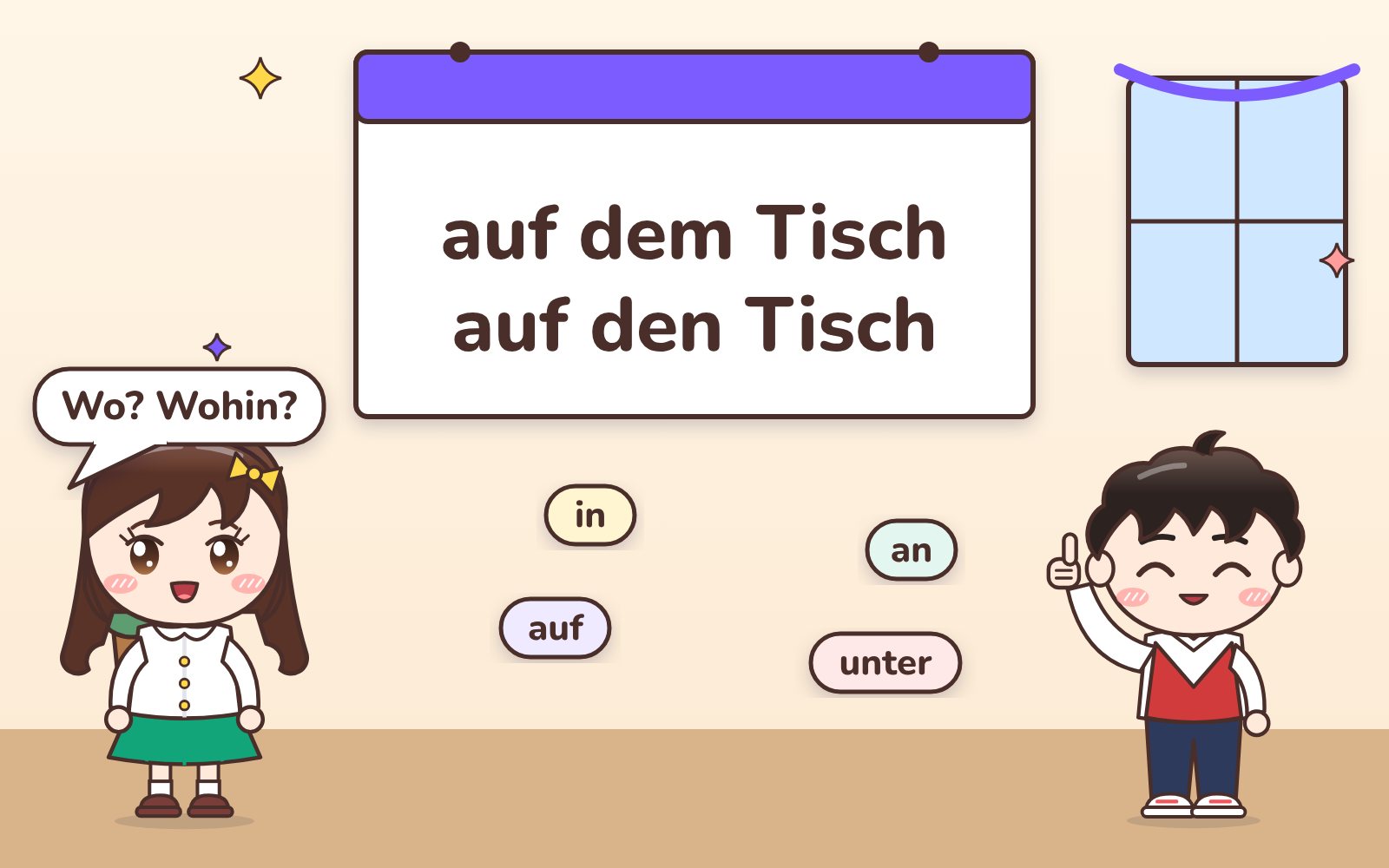
Nine German prepositions can take two cases: an, auf, hinter, in, neben, über, unter, vor, zwischen. That is why learners hesitate between auf dem Tisch and auf den Tisch. The good news: you don't have to memorise anything per noun. One question decides the case every time. English makes a similar (but optional) difference with in / into and on / onto.
The rule: Wo? → dative, Wohin? → accusative
- Wo? (where?) — something is at a place, no change of place → dative.
- Wohin? (where to?) — something moves to a place → accusative.
The preposition stays the same; only the article changes (and the plural dative adds -n to the noun):
| Noun | Wo? (dative) | Wohin? (accusative) |
|---|---|---|
| der Tisch | auf dem Tisch | auf den Tisch |
| die Wand | an der Wand | an die Wand |
| das Bett | unter dem Bett | unter das Bett |
| die Stühle (pl.) | zwischen den Stühlen | zwischen die Stühle |
- Ich bin in der Küche. — I'm in the kitchen.
- Ich gehe in die Küche. — I'm going into the kitchen.
- Die Katze schläft unter dem Bett. — The cat is sleeping under the bed.
- Die Katze läuft unter das Bett. — The cat runs under the bed.
legen/liegen, stellen/stehen, hängen
Three verb pairs make the rule almost automatic. The "action" verb (someone puts something somewhere) goes with Wohin? + accusative; the "state" verb (something is there) goes with Wo? + dative. Legen = lay flat, stellen = stand upright. Hängen is both verbs, but with different past participles.
| Wohin? + accusative (action) | Wo? + dative (state) |
|---|---|
| legen — hat gelegt | liegen — hat gelegen |
| stellen — hat gestellt | stehen — hat gestanden |
| hängen — hat gehängt | hängen — hat gehangen |
- Ich lege das Handy auf den Tisch. — I put the phone on the table.
- Das Handy liegt auf dem Tisch. — The phone is (lying) on the table.
- Er stellt die Flasche in den Kühlschrank. — He puts the bottle in the fridge.
- Die Flasche steht im Kühlschrank. — The bottle is in the fridge.
- Wir hängen das Bild an die Wand. — We hang the picture on the wall.
- Das Bild hängt an der Wand. — The picture is hanging on the wall.
im, ins, am, ans
With masculine and neuter nouns, in and an usually merge with the article. With feminine nouns there is no short form: in der Stadt, in die Stadt.
| Long form | Short form | Question |
|---|---|---|
| in dem | im | Wo? |
| in das | ins | Wohin? |
| an dem | am | Wo? |
| an das | ans | Wohin? |
- Wir gehen ins Kino. — We're going to the cinema.
- Wir sind im Kino. — We're at the cinema.
- Ich fahre ans Meer. — I'm going to the seaside.
- Ich bin am Meer. — I'm at the seaside.
- Er geht in die Stadt. — He's going into town.
Common mistakes
- ✗ Ich lege das Buch auf dem Tisch. → ✓ Ich lege das Buch auf den Tisch. (legen = movement → accusative)
- ✗ Das Buch legt auf dem Tisch. → ✓ Das Buch liegt auf dem Tisch. (the book is just there → liegen)
- ✗ Ich gehe im Kino. → ✓ Ich gehe ins Kino. (gehen + destination → ins)
Quick check
- Ich hänge die Jacke an ___ Haken. (der Haken)
Answer
den — hängen as an action, Wohin? → accusative: an den Haken.- Der Schlüssel ___ unter dem Sofa. (liegen or legen?)
Answer
liegt — the key is simply there (Wo?, dative dem Sofa).- Wir gehen heute Abend ___ Theater. (im or ins?)