German lessons · German grammar · A1
German Word Order: The Verb in Second Place
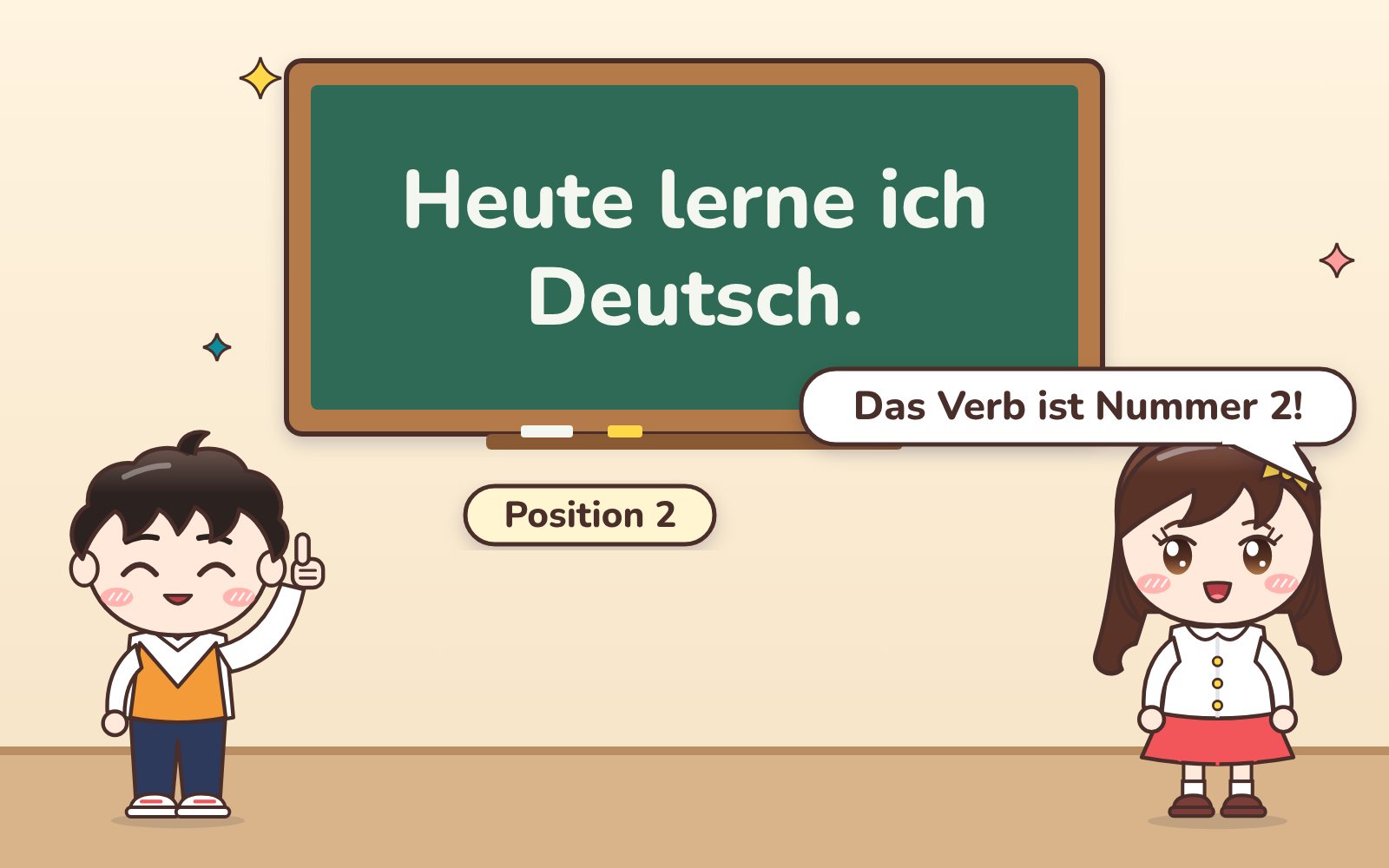
German word order looks free at first: you can start a sentence with "I", with "today" or even with the object. But one thing is fixed — the position of the conjugated verb. Learners stumble because they carry over the English pattern ("Today I go…") or forget that the second part of the verb belongs at the end of the sentence.
The verb in position 2
In a statement the conjugated verb is always the second element. An "element" can be one word or a whole phrase (am Montag, seit einem Jahr). If something other than the subject comes first, the subject moves to the place right after the verb.
| Position 1 | Position 2 (verb) | Rest |
|---|---|---|
| Ich | lerne | heute Deutsch. |
| Heute | lerne | ich Deutsch. |
| Am Montag | beginnt | der Kurs. |
| Deutsch | lerne | ich seit einem Jahr. |
- Ich lerne heute Deutsch. — I'm studying German today.
- Heute lerne ich Deutsch. — Today I'm studying German.
- Am Montag beginnt der Kurs. — The course starts on Monday.
- Deutsch lerne ich seit einem Jahr. — I've been learning German for a year.
Note: und, aber, oder don't count as an element: Ich bin müde, aber ich arbeite.
Questions
In a yes/no question the verb comes first. In a W-question the question word comes first and the verb second — so the "verb in position 2" rule still holds.
| Type | Position 1 | Position 2 | Rest |
|---|---|---|---|
| Yes/no | Kommst | du | heute? |
| W-question | Wo | wohnst | du? |
| W-question | Wann | beginnt | der Kurs? |
Common question words: wer (who), was (what), wo (where), woher (where from), wohin (where to), wann (when), wie (how), warum (why).
- Kommst du heute? — Are you coming today?
- Hast du Zeit? — Do you have time?
- Wo wohnst du? — Where do you live?
- Was machst du am Wochenende? — What are you doing at the weekend?
- Wann beginnt der Kurs? — When does the course start?
The sentence bracket (Satzklammer)
When a sentence has two verb parts, they form a "bracket": the conjugated verb stays in position 2 (or 1 in a yes/no question), and the infinitive (after a modal verb) or the past participle (in the perfect) goes to the very end. Everything else sits in between.
| Position 1 | Verb 1 | Middle | Verb 2 (end) |
|---|---|---|---|
| Ich | kann | heute nicht | kommen. |
| Wir | müssen | morgen früh | arbeiten. |
| Ich | habe | gestern Pizza | gegessen. |
| Sie | ist | am Samstag nach Berlin | gefahren. |
- Ich kann heute nicht kommen. — I can't come today.
- Wir müssen morgen früh arbeiten. — We have to work early tomorrow.
- Ich habe gestern Pizza gegessen. — I ate pizza yesterday.
- Sie ist am Samstag nach Berlin gefahren. — She went to Berlin on Saturday.
- Kannst du mir helfen? — Can you help me?
TeKaMoLo: a rough guide for the middle
When several details stand in the middle of a sentence, a common order is Temporal (when?) – Kausal (why?) – Modal (how?) – Lokal (where/where to?). It is a tendency, not a strict law, but it always sounds natural.
| Temporal | Kausal | Modal | Lokal |
|---|---|---|---|
| morgen | wegen der Arbeit | mit dem Zug | nach Berlin |
- Ich fahre morgen mit dem Zug nach Berlin. — I'm going to Berlin by train tomorrow.
- Ich fahre morgen wegen der Arbeit mit dem Zug nach Berlin. — Tomorrow I'm going to Berlin by train because of work.
- Wir essen heute Abend zusammen im Restaurant. — We're eating together at a restaurant tonight.
Common mistakes
- ✗ Heute ich gehe ins Kino. → ✓ Heute gehe ich ins Kino. (verb second)
- ✗ Wo du wohnst? → ✓ Wo wohnst du? (verb right after the question word)
- ✗ Ich habe gegessen Pizza. → ✓ Ich habe Pizza gegessen. (participle at the end)
Quick check
- Start with morgen: ich / arbeite / morgen
Answer
Morgen arbeite ich.- Turn into a yes/no question: Du hast Zeit.
Answer
Hast du Zeit?- Put machen in the right place: Ich will heute Hausaufgaben …