German lessons · Everyday German phrases · A2
Ich habe seit drei Tagen …: describing symptoms at the doctor's in Germany
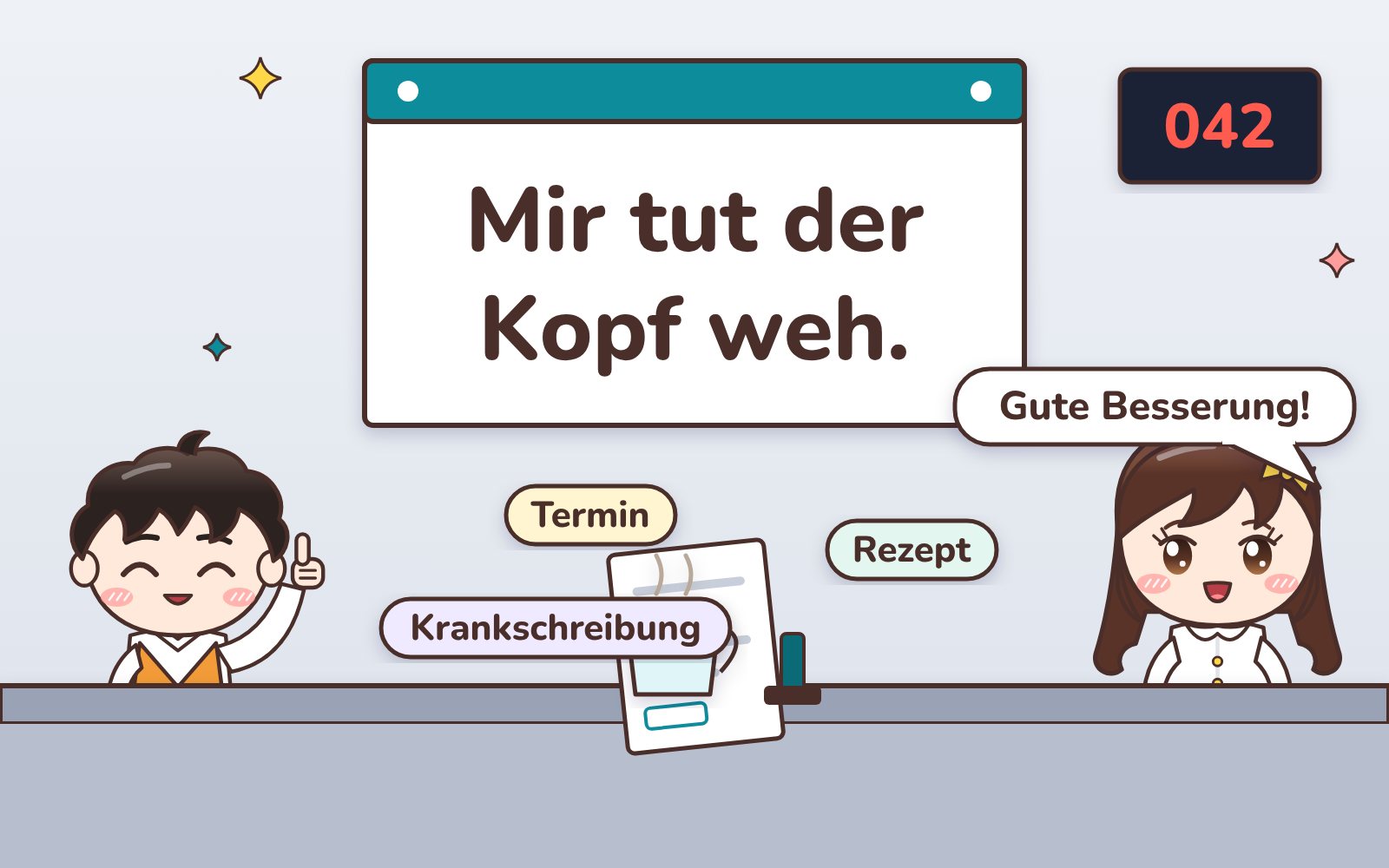
In Germany, when you feel ill you usually go first to a family doctor (Hausarzt) at their practice (Praxis), not to a hospital. Reception, symptoms, sick note, prescription — all in German, and all while you're feeling rotten. The good news: doctors ask almost the same questions every time. If you can say where it hurts, since when and how much, the appointment becomes much easier.
Booking and checking in
- Ich hätte gern einen Termin, möglichst bald. — I'd like an appointment, as soon as possible. Start like this on the phone or at the desk. Many practices also take online bookings.
- Ich bin zum ersten Mal hier. — It's my first time here. New patients usually get a form about their details and medical history (Anamnesebogen).
- Haben Sie Ihre Versichertenkarte dabei? — Do you have your insurance card with you? You'll hear this at reception all the time. The public insurance card is also called Gesundheitskarte. Answer: Ja, hier bitte.
- Nehmen Sie bitte noch im Wartezimmer Platz. — Please take a seat in the waiting room. Wait in the Wartezimmer until your name is called.
Describing your symptoms
- Ich habe seit drei Tagen Halsschmerzen. — I've had a sore throat for three days. seit + dative says since when. Kopfschmerzen (headache), Bauchschmerzen (stomach ache) and Rückenschmerzen (back pain) work the same way. Note the present tense — English uses "I've had", German says ich habe.
- Mir tut der Rücken weh. / Mir tut das Knie weh. — My back hurts. / My knee hurts. The person in pain is mir (dative); the body part is the subject. For more than one: Mir tun die Füße weh.
- Ich habe Fieber. — I have a temperature. If you measured it: Ich habe 38,5 Grad Fieber.
- Mir ist schwindelig. / Mir ist übel. — I feel dizzy. / I feel sick. Again with mir — not Ich bin schwindelig.
- Ich huste viel und meine Nase läuft. — I'm coughing a lot and my nose is running.
Sick notes and prescriptions
- Ich brauche eine Krankschreibung. — I need a sick note. The official name is Arbeitsunfähigkeitsbescheinigung (AU). With public insurance the practice usually sends it electronically (eAU) to your health insurer, and your employer retrieves it there. You still have to tell your employer yourself that you are ill.
- Wie lange bin ich krankgeschrieben? — How long am I signed off?
- Können Sie mir etwas verschreiben? — Could you prescribe something? With a prescription (Rezept) you go to the pharmacy (Apotheke). With public insurance it is usually an E-Rezept now — you just show your insurance card.
- Wie oft soll ich das nehmen? — How often should I take it? A typical answer: Dreimal täglich nach dem Essen. (three times a day after meals)
- Ich brauche eine Überweisung zum Facharzt. — I need a referral to a specialist. The family doctor gives you this (on paper or electronically) for a dermatologist, orthopaedist and so on.
Short dialogue
In the family doctor's consulting room
A: Guten Tag, Frau Park. Was führt Sie zu mir? — Hello, Ms Park. What brings you here?
B: Ich habe seit drei Tagen Halsschmerzen und Fieber. — I've had a sore throat and a temperature for three days.
A: Haben Sie auch Husten? — Do you have a cough too?
B: Ja, ein bisschen. Und mir tut der Kopf weh. — Yes, a little. And my head hurts.
A: Das ist wahrscheinlich eine Erkältung. Ich schreibe Sie bis Freitag krank. — It's probably a cold. I'll sign you off until Friday.
B: Danke. Muss ich etwas nehmen? — Thank you. Do I need to take anything?
A: Trinken Sie viel und ruhen Sie sich aus. Gute Besserung! — Drink plenty and get some rest. Get well soon!
Watch out
- Krankenhaus is not your GP — the everyday doctor is the Praxis. A Krankenhaus is a hospital, with wards and an emergency department.
- Mir ist kalt, not Ich bin kalt — to say you feel cold, use Mir ist kalt. Ich bin kalt sounds like "I'm a cold person".
- bekommen ≠ become — Ich bekomme ein Rezept. means "I get a prescription".
- When the practice is closed — if it's not life-threatening but can't wait, call 116117 (on-call medical service); in a life-threatening emergency call 112.
- Gute Besserung! — "Get well soon!" Say it to ill colleagues too.
Quick check
- How do you say "My back has hurt for a week"?
Answer
Ich habe seit einer Woche Rückenschmerzen. — or: Mir tut seit einer Woche der Rücken weh.- "I feel dizzy": Ich bin schwindelig or Mir ist schwindelig?
Answer
Mir ist schwindelig. — physical feelings use mir + ist.- You have a high temperature at night, the practice is closed, and it isn't life-threatening. Which number do you call?