German lessons · Everyday German phrases · A2
Du or Sie? How to Switch to First-Name Terms in German
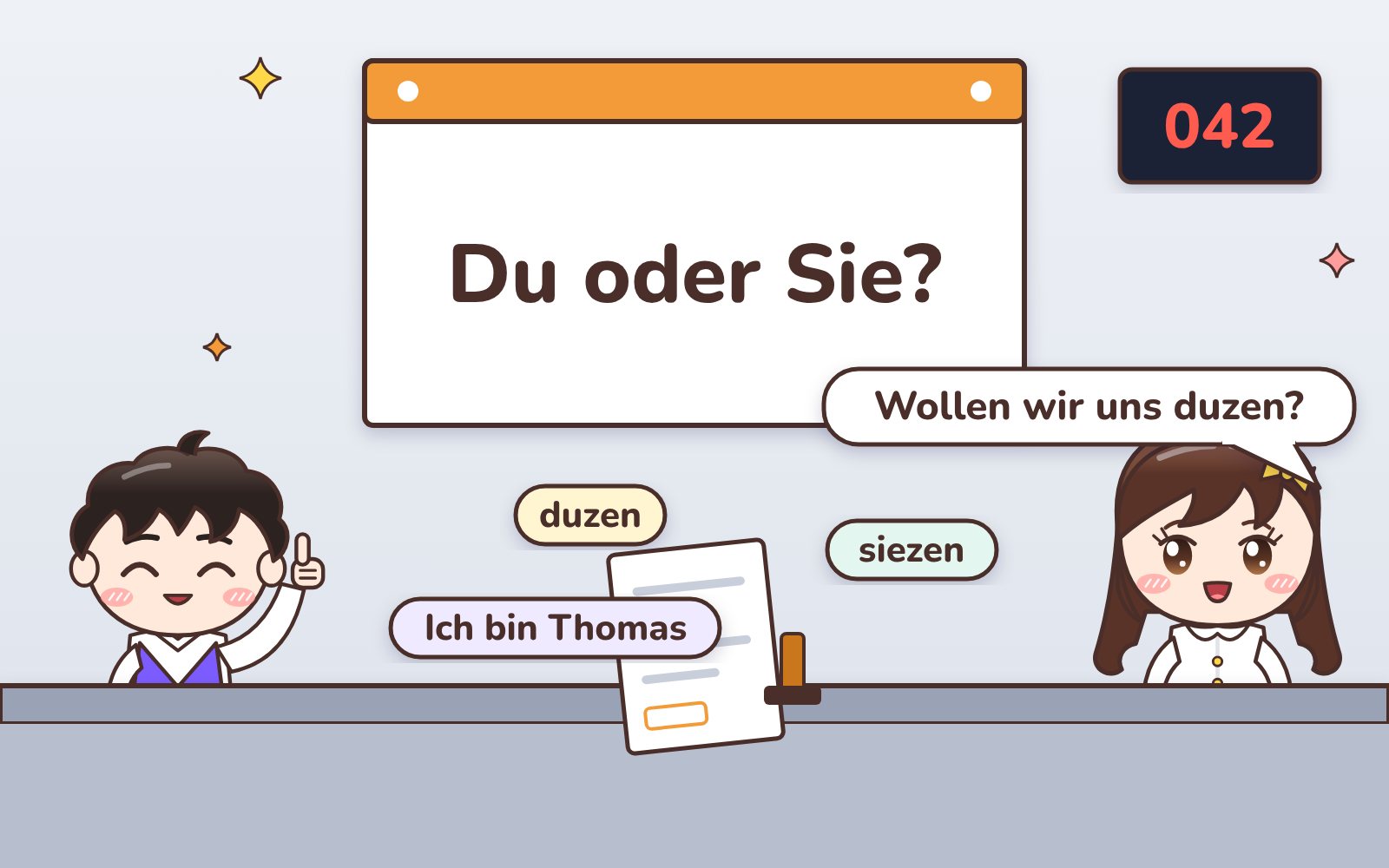
German has two words for "you": du for people you are close to, and the polite Sie. Many languages have something similar, but German has its own rules. What matters most is how close you are, not just age, and the moment you switch to du is usually agreed out loud. If a colleague one day asks "Wollen wir uns duzen?", it's a friendly sign. The verb duzen means "to say du", and siezen means "to say Sie".
The basics: when in doubt, Sie
- Entschuldigung, können Sie mir helfen? — Excuse me, could you help me? Sie is the default with adults you don't know, shop staff, doctors and officials. It's the safe choice: it is never rude.
- Kannst du mir helfen? — Can you help me? For family, friends, children and classmates. Students and young people often use du with each other from the start.
- Duzen oder siezen wir uns? — Shall we say du or Sie? If you're not sure, it's fine to ask. Asked with a smile, it breaks the ice.
Suggesting du
- Wollen wir uns duzen? — Shall we use du? (Shall we go on first-name terms?) The most common way to offer. Usually the older or more senior person, or the host, suggests it.
- Wir können uns gerne duzen. — We can happily say du. A softer way to offer it.
- Sag ruhig du! — Feel free to say du! Friendly, when someone keeps saying Sie to you.
- Ich bin übrigens Thomas. — I'm Thomas, by the way. Introducing yourself with only your first name is in practice an offer of du.
Answering
- Ja, gerne! Ich bin Ji-woo. — Yes, sure! I'm Ji-woo. Accepting with your first name sounds natural.
- Ich würde lieber beim Sie bleiben, wenn das okay ist. — I'd rather stay with Sie, if that's okay. You can say no. It's not common and may feel a little distant, so giving a reason helps.
- Darf ich du sagen? — May I say du? For carefully suggesting it yourself to a neighbour or colleague of about your age.
Who says what
| Situation | Usually | Notes |
|---|---|---|
| Offices, police, doctors | Sie | even if you've known them for years |
| Shop and restaurant staff | Sie | du is common in young cafés and bars |
| Work | depends on the company | start-ups and IT: du from day one; banks and law firms: mostly Sie |
| Neighbours | Sie at first | people of a similar age often switch quickly |
| University, clubs, sports teams | du | professors: usually Sie |
| Ads, apps, IKEA | du | to sound friendly |
There are mixed forms too. The Hamburger Sie is a first name with Sie: Thomas, können Sie …? The Münchner Du is the opposite, a surname with du: Frau Huber, kannst du …?
Short dialogue
In the office, after working together for about a year
A: Frau Kim, haben Sie kurz Zeit? — Ms Kim, do you have a moment?
B: Ja, natürlich. Worum geht es? — Yes, of course. What is it about?
A: Ach, übrigens: Wir arbeiten jetzt schon ein Jahr zusammen. Wollen wir uns nicht duzen? Ich bin Thomas. — Oh, by the way: we've been working together for a year now. Shall we say du? I'm Thomas.
B: Ja, gerne! Ich bin Ji-woo. — Yes, I'd like that! I'm Ji-woo.
A: Super, Ji-woo. Kannst du mir die Datei noch schicken? — Great, Ji-woo. Could you send me the file?
B: Klar, mache ich sofort. — Sure, I'll do it right away.
Watch out
- Always capitalise Sie. Polite Sie (you) and sie (she, they) sound the same. In writing, the capital S tells them apart, and Ihnen and Ihr are capitalised too.
- The senior person usually offers du. Suggesting du to someone older or more senior than you can feel awkward. Waiting is the safe option.
- No du with police or officials. It sounds rude and in bad cases can even be treated as an insult (Beleidigung).
- Once du, always du. People almost never go back to Sie, so it's fine to think for a second before you accept.
Quick check
- You ask a clerk at the Bürgeramt about documents. Do you use du or Sie?
Answer
Sie. For example: Können Sie mir sagen, welche Unterlagen ich brauche?- A colleague asks "Wollen wir uns duzen?" Accept in a natural way.
Answer
Ja, gerne! Ich bin … (your first name). Adding your name sounds most natural.- Frau Huber, kannst du mir helfen? — Which form is this?