German lessons · Everyday German phrases · A1
Hello and Goodbye in German: Who Says What, and Where
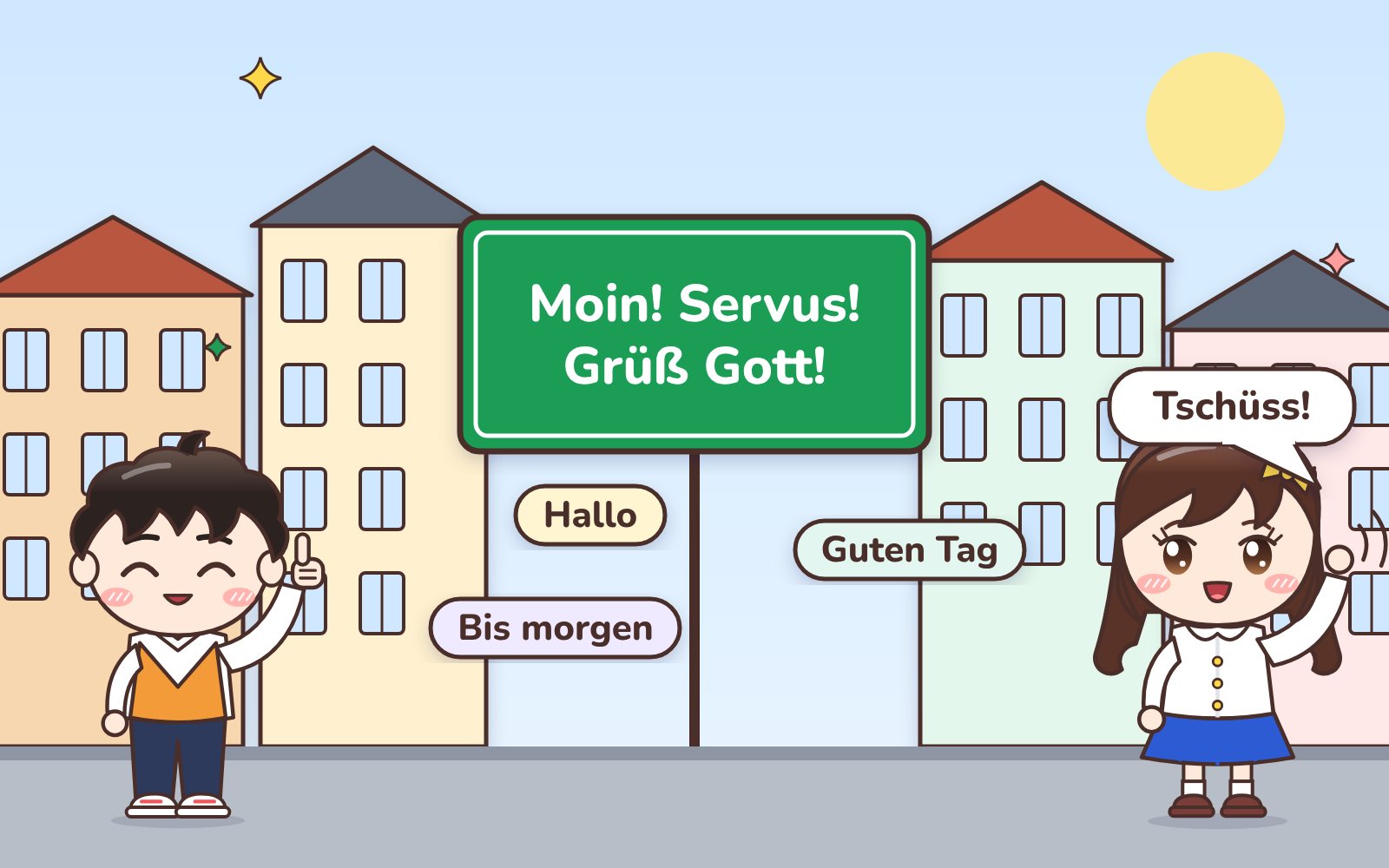
You say hello and goodbye dozens of times a day — to the bus driver, the cashier, a neighbour on the stairs, colleagues at work. In Germany people greet each other more often than many newcomers expect: when you walk into a small shop, a doctor's waiting room or a lift, a short greeting is normal. The good news: a handful of words covers almost everything. You just need to know which ones fit the time of day, the region and the person in front of you.
Saying hello
- Hallo! — Hello! / Hi! Works almost everywhere, from friends to shops; a little informal, but nobody minds. The answer is simply Hallo!
- Guten Morgen! / Guten Tag! / Guten Abend! — Good morning! / Good day! / Good evening! The safe, polite choice with Sie: Morgen until about 10–11 a.m., Tag during the day, Abend from about 6 p.m. People answer with the same words; in speech you often hear just Morgen! or Tag!
Regional greetings
- Moin! — Hi! / Hello! Mostly in northern Germany (Hamburg, Bremen, Schleswig-Holstein, much of Lower Saxony). Despite the sound, it is used at any time of day, also with strangers and in shops. Answer: Moin!
- Grüß Gott! — Hello! (literally "God greet you") Mostly in Bavaria, parts of Baden-Württemberg and in Austria. It is the normal, polite greeting there, also with strangers; it is not especially religious. Answer: Grüß Gott! or Guten Tag!
- Servus! — Hi! / Bye! Mostly in Bavaria and Austria, informal, for friends and people you say du to. It works both for hello and for goodbye.
Saying goodbye
- Tschüss! — Bye! The everyday goodbye in most of Germany — with friends, colleagues, and also with cashiers and in shops. In Bavaria and Austria people often prefer Servus or other local words, though Tschüss is understood.
- Auf Wiedersehen! — Goodbye! Formal and always correct: at offices, the doctor's, with older people or anyone you say Sie to. On the phone it becomes Auf Wiederhören! ("until we hear each other again").
- Bis später! / Bis morgen! — See you later! / See you tomorrow! When you will see the person again soon; fine with du and with Sie. Other forms: Bis Montag!, Bis bald! (see you soon).
At work
- Schönen Feierabend! — Have a nice evening (after work)! Said when you or others leave work, and also to the cashier in the evening. Answer: Danke, gleichfalls! (thanks, you too) or Danke, Ihnen auch! / Danke, dir auch!
- Schönes Wochenende! — Have a nice weekend! On Fridays (or the last day before the weekend), at work, in shops, among neighbours. Same answer: Danke, gleichfalls!
- Mahlzeit! — (literally "mealtime") a lunchtime greeting In many offices and workplaces, colleagues say it in the corridor or canteen roughly between 11:30 and 2 p.m. — as a greeting, not as "enjoy your meal". The answer is Mahlzeit!
Short dialogue
In the office corridor, 12:30.
A: Mahlzeit! — Hi! (lunchtime greeting)
B: Mahlzeit! Gehen Sie auch in die Kantine? — Hi! Are you going to the canteen too?
A: Nein, heute nicht. Bis später! — No, not today. See you later!
Friday, 5 p.m.
A: So, ich mache Feierabend. Schönes Wochenende! — Right, I'm off for the day. Have a nice weekend!
B: Danke, gleichfalls! Bis Montag! — Thanks, you too! See you on Monday!
A: Tschüss, bis Montag! — Bye, see you Monday!
Watch out
- Mahlzeit is not "bon appétit". At the table you say Guten Appetit! Mahlzeit is a workplace greeting around lunch; not everyone likes it (some find it old-fashioned), but answering Mahlzeit! is always fine.
- Grüß Gott and Servus outside the south. In Berlin or Hamburg people understand them, but they sound clearly Bavarian or Austrian. In the north, Moin or Hallo fits better — and in Munich Moin sounds northern.
- Tschüss to officials. At the Bürgeramt, the Ausländerbehörde or in a job interview, Auf Wiedersehen is the safe choice. If the official says Tschüss first, you can answer Tschüss too.
- Gute Nacht is not a greeting. It means "good night" before going to bed. In the evening, say Guten Abend when you arrive.
Quick check
- It is 9 a.m. and you enter the doctor's waiting room. What do you say?
Answer
Guten Morgen! (Hallo is also fine.)- A colleague says Schönen Feierabend! to you. What do you answer?
Answer
Danke, gleichfalls! — or Danke, Ihnen auch! (Sie) / Danke, dir auch! (du)- In a bakery in Munich, the saleswoman says Grüß Gott! What does it mean, and what can you answer?