German lessons · Everyday German phrases · B1
Komm doch mal vorbei! doch, mal, ja, halt, eben — the little words that make German sound natural
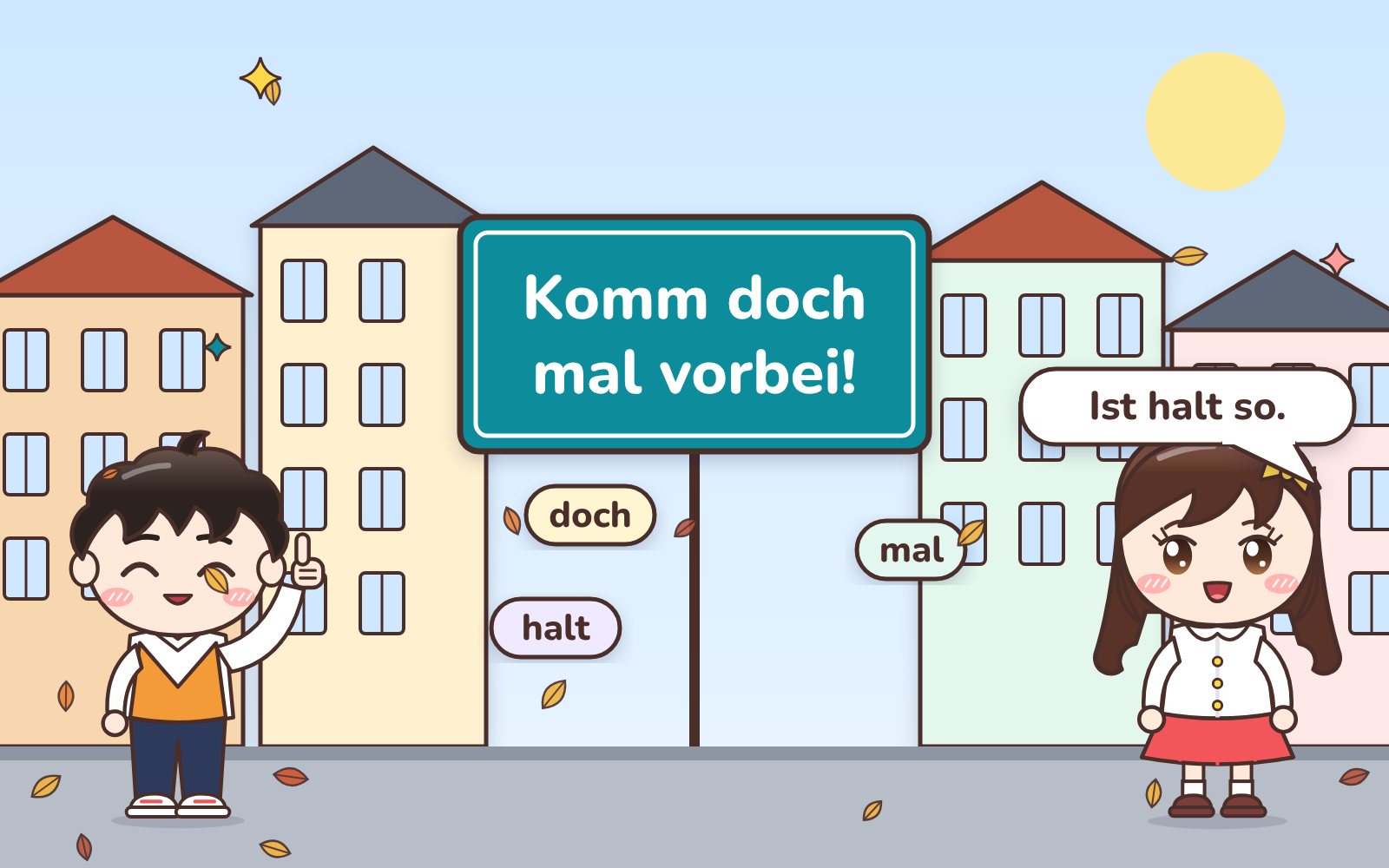
Live in Germany for a while and you'll hear these all the time: Komm doch mal vorbei! Das ist ja super! Ist halt so. Look up doch in a dictionary and you get "but", mal is "once", ja is "yes" — yet none of that is what they mean here. These little words are called modal particles (Modalpartikeln). They don't change the information in a sentence, but they change its tone and mood. Without them German sounds stiff and cold; once you understand them, you can hear much better how people feel. You don't need to use them all from day one. Start with mal and doch.
Softening requests and suggestions: mal, doch, doch mal
- Kannst du mal kurz kommen? — Can you come here for a sec? mal adds a "just quickly, no big deal" feel, so the request sounds easy. It's used a lot at work, too.
- Schauen Sie mal hier. — Just have a look here. Even an imperative with Sie sounds friendly with mal.
- Komm doch mit! — Come along! doch says "why not, it'd be nice" — a gentle push for someone who's hesitating.
- Setzen Sie sich doch. — Do sit down. A friendly invitation to a guest.
- Ruf mich doch mal an! — Give me a call sometime! doch mal is the most common pair, and the order is always doch mal.
Something we both know: ja
- Das ist ja super! — Oh, that's great! For a pleasant surprise you didn't expect.
- Du weißt ja, ich arbeite am Samstag. — You know I work on Saturdays. To remind someone of something they already know.
- Da bist du ja! — Oh, there you are! When you find the person you were looking for.
Note: this ja comes in the middle of the sentence and is unstressed. It's not the same as Ja, (yes) at the start of a sentence.
That's just how it is: halt, eben
- Das ist halt so. — That's just the way it is. For accepting something you can't change. Especially common in southern Germany and Austria.
- Dann nehmen wir eben den nächsten Zug. — Then we'll just take the next train. When plans fall through: "oh well, let's do that then". In the north you hear eben more than halt.
- Eben! — Exactly! On its own, it's a strong way to agree with what someone said.
Curious questions: denn
- Was ist denn los? — What's going on? It makes a question less stiff and more interested.
- Wo wohnst du denn? — So where do you live? For asking something naturally in the middle of a conversation.
denn appears almost only in questions. Said sharply, it can sound annoyed, like "what on earth …!", so keep your voice soft.
Short dialogue
A: Hallo! Da bist du ja! — Hi! There you are! B: Sorry, die S-Bahn hatte mal wieder Verspätung. — Sorry, the S-Bahn was late again. A: Ist halt so. Komm doch rein! — That's how it is. Come on in! B: Danke. Was gibt's denn heute? — Thanks. So what are we having today? A: Gulasch. Du isst ja kein Schweinefleisch, oder? Das ist Rind. — Goulash. You don't eat pork, right? This is beef. B: Super, dann probiere ich mal. — Great, I'll give it a try then.
Watch out
- mal ≠ einmal — in Ich war einmal in Wien. (I've been to Vienna once), einmal counts how often. In Komm mal her! mal only sets the tone.
- doch has another meaning too — Doch! as a stressed one-word answer contradicts a negative question. (Kommst du nicht? — Doch! Aren't you coming? — Yes, I am!)
- Don't overdo it — one per sentence, two at most, is plenty. They are rare in formal emails and documents.
- Don't try to translate them — they work a bit like English "just", "you know" or "well". Learn them from the situation and the intonation rather than from a dictionary meaning.
Quick check
- Make Kannst du mir helfen? a softer request.
Answer
Kannst du mir mal helfen? (or Kannst du mir mal kurz helfen?)- Your train has been cancelled. Say "Then we'll just take the bus" with eben.
Answer
Dann nehmen wir eben den Bus. (halt works too: Dann nehmen wir halt den Bus.)- What feeling does ja give in Das ist ja super!?