German lessons · Everyday German phrases · A2
Ich rufe wegen … an: German phone calls from hello to goodbye
Living in Germany, you'll make more phone calls than you might expect: booking a doctor's appointment, reporting a fault to your landlord or the property management (Hausverwaltung), asking your insurance a question. You can't see the other person and they speak fast, so it's stressful — but phone German runs on set phrases. Prepare a few and it gets much easier. And there's one German habit to know: people often answer the phone not with "hello" but with their own name.
Answering and introducing yourself
- Müller. / Hier ist Müller. — Müller speaking. At home or on a private mobile, many people just say their surname. It surprises newcomers, but it's very common.
- Praxis Dr. Weber, Sie sprechen mit Frau Schulz. Was kann ich für Sie tun? — Dr Weber's practice, Ms Schulz speaking. How can I help you? Companies and practices answer with the organisation's name plus the person's name.
- Guten Tag, hier spricht Min-jun Kim. — Hello, this is Min-jun Kim. When you're the caller, say your name first. Mein Name ist … works too.
Saying why you're calling
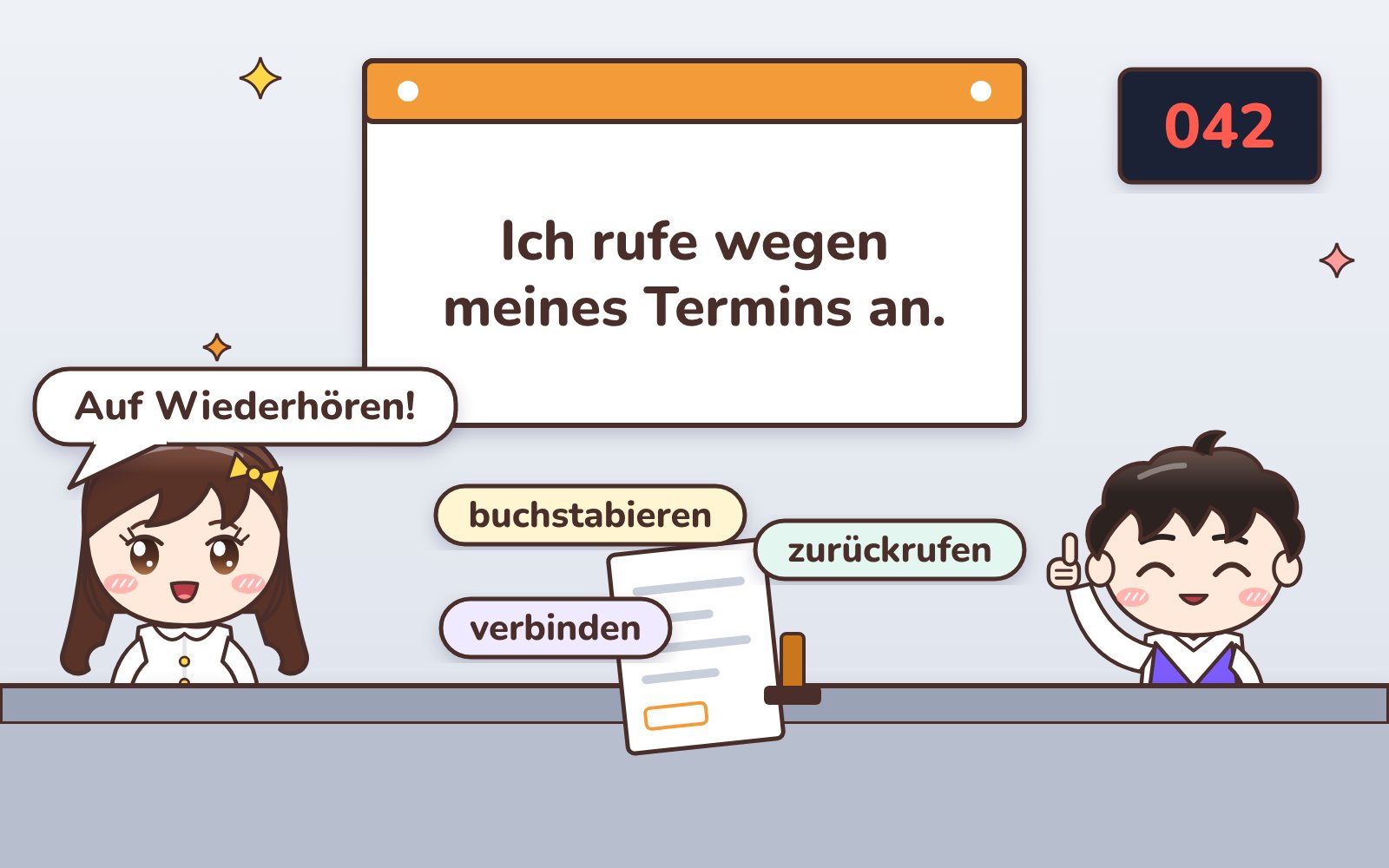
- Ich rufe wegen meines Termins an. — I'm calling about my appointment. wegen officially takes the genitive, but in conversation you'll often hear the dative too: wegen dem Termin.
- Ich rufe an, weil die Heizung nicht funktioniert. — I'm calling because the heating isn't working. Use weil when you want to give the reason as a full sentence.
- Ich hätte eine Frage zu meiner Rechnung. — I have a question about my bill. A very polite, natural opener.
- Ich möchte gern einen Termin vereinbaren. — I'd like to make an appointment. Works for doctors, offices and hairdressers alike.
When you can't hear well, and spelling
- Können Sie das bitte buchstabieren? — Could you spell that, please? Essential when you note down names or addresses.
- Ich buchstabiere: K wie Kaufmann, I wie Ida, M wie Martha. — Let me spell it: K as in Kaufmann, I as in Ida, M as in Martha. This is how Germans spell on the phone — very handy for your own name.
- Entschuldigung, die Verbindung ist schlecht. — Sorry, the line is bad. The other person will usually repeat it, more slowly.
- Können Sie bitte etwas langsamer sprechen? — Could you speak a bit more slowly, please?
Being put through, messages, calling back
- Könnten Sie mich bitte mit Frau Becker verbinden? — Could you put me through to Ms Becker, please?
- Einen Moment, ich verbinde Sie. — One moment, I'll put you through. If you hear this, just hold the line.
- Kann ich eine Nachricht hinterlassen? — Can I leave a message?
- Können Sie mich bitte zurückrufen? Meine Nummer ist … — Could you call me back, please? My number is … Saying numbers in pairs makes them easier to follow. To avoid confusion with drei, two is often said as zwo.
Short dialogue
Calling the doctor's to move an appointment
A: Praxis Dr. Weber, Schulz am Apparat. Guten Tag! — Dr Weber’s practice, Schulz speaking. Hello!
B: Guten Tag, hier spricht Kim. Ich rufe wegen meines Termins am Dienstag an. — Hello, this is Kim. I'm calling about my appointment on Tuesday.
A: Wie ist Ihr Name, bitte? Können Sie ihn buchstabieren? — What's your name, please? Could you spell it?
B: K wie Kaufmann, I wie Ida, M wie Martha. Ich kann am Dienstag leider nicht kommen. — K, I, M. Unfortunately I can't come on Tuesday.
A: Kein Problem. Passt Ihnen Donnerstag um 10 Uhr? — No problem. Does Thursday at 10 suit you?
B: Ja, das passt gut. Vielen Dank! — Yes, that works. Thank you very much!
A: Gern. Auf Wiederhören! — You're welcome. Goodbye!
B: Auf Wiederhören! — Goodbye!
Watch out
- Auf Wiederhören — on the phone, say this ("until we hear each other again") instead of Auf Wiedersehen. With friends, Tschüss! is fine.
- Answering with Hallo? — fine on your private phone, but at work answer with the company name and your name.
- The spelling alphabet — the official standard changed in 2022 to city names (K wie Köln, M wie München). The old first names like Kaufmann, Ida and Martha are still widely used, so it helps to recognise both.
- am Apparat — "Schulz am Apparat" just means "Schulz speaking". It's not about a machine.
Quick check
- You call someone and they answer only "Meier." What does that mean?
Answer
The person answering is called Meier. Many Germans answer the phone with their surname.- How do you say "I'm calling about my contract (Vertrag)"?
Answer
Ich rufe wegen meines Vertrags an.- Which polite goodbye do you use to end a phone call?