German lessons · Everyday German phrases · A2
Leider funktioniert … nicht: how to complain politely in German
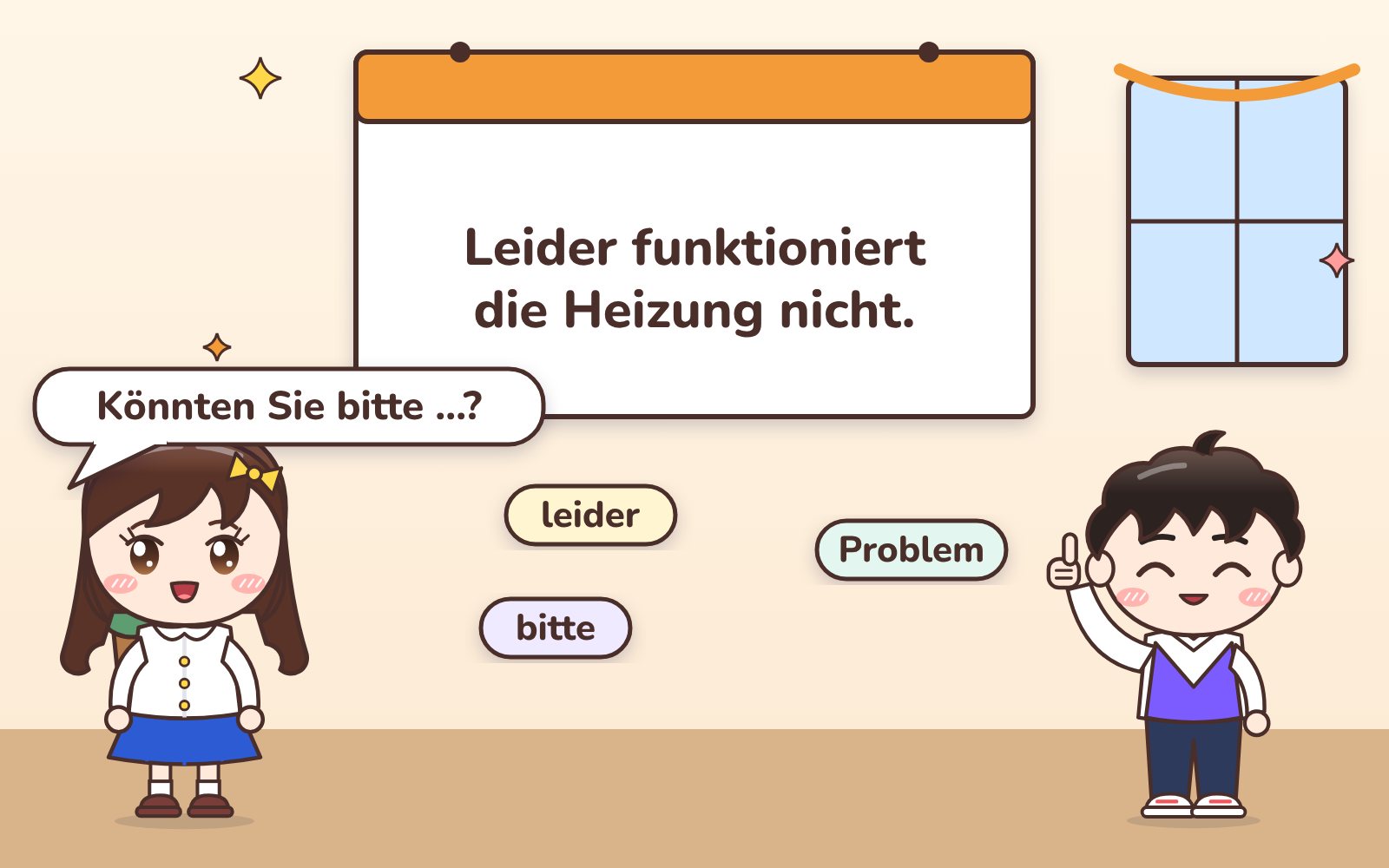
In Germany, saying clearly that something is wrong isn't rude. In fact, if you keep quiet and put up with it, people will assume there's no problem. What matters is how you say it. Instead of raising your voice, bring up the problem with Leider (unfortunately) and ask for what you want with Könnten Sie bitte …? Most shops, offices and landlords will then listen calmly. Use Sie with people you don't know.
Bringing up the problem
- Entschuldigung, ich habe ein Problem. — Excuse me, I have a problem. The safest way to start when you call over a member of staff.
- Leider funktioniert die Heizung nicht. — Unfortunately the heating isn't working. Starting with Leider sounds calm and polite.
- Ich habe ein Problem mit meiner Bestellung. — There's a problem with my order. After mit comes the dative (meiner, meinem).
- Das ist leider nicht das, was ich bestellt habe. — I'm afraid this isn't what I ordered. For when the wrong dish comes in a restaurant.
- Der Toaster ist kaputt. Ich habe ihn letzte Woche gekauft. — The toaster is broken. I bought it last week. When you take it back to the shop, bring the receipt (der Kassenbon) too.
Asking for what you want
- Könnten Sie sich das bitte ansehen? — Could you have a look at it, please? For a repair person or a member of staff.
- Könnte ich das bitte umtauschen? — Could I exchange this, please?
- Ich hätte gern mein Geld zurück. — I'd like my money back. Note: getting a refund for something that isn't faulty is not a legal right; it depends on the shop's policy.
- Wann könnte jemand vorbeikommen? — When could someone come round? For calling your landlord or the property management company (die Hausverwaltung).
When it still isn't sorted
- Ich habe schon zweimal angerufen. — I've already called twice. Stating facts instead of feelings carries much more weight.
- Könnte ich bitte mit Ihrem Vorgesetzten sprechen? — Could I speak to your manager, please? A polite last step.
- Ich möchte mich beschweren. — I'd like to make a formal complaint. This is strong, so it's best not to start with it.
Short dialogue: calling the landlord
A: Guten Tag, hier ist Kim aus der Lindenstraße 12. — Hello, this is Kim from Lindenstraße 12. B: Guten Tag, Frau Kim. Was kann ich für Sie tun? — Hello, Ms Kim. What can I do for you? A: Leider funktioniert die Heizung im Bad seit gestern nicht. — Unfortunately the heating in the bathroom hasn't been working since yesterday. B: Oh, das tut mir leid. Haben Sie die Heizung schon entlüftet? — Oh, I'm sorry. Have you bled the radiator yet? A: Ja, das habe ich schon versucht. Könnten Sie bitte jemanden schicken? — Yes, I've already tried that. Could you send someone, please? B: Natürlich. Der Hausmeister kommt morgen Vormittag. — Of course. The caretaker will come tomorrow morning. A: Super, vielen Dank für Ihre Hilfe! — Great, thank you very much for your help!
Watch out
- Ich will … — "I want …" sounds very harsh when you're complaining. Use Ich hätte gern … or Könnten Sie …? instead.
- Das ist nicht mein Problem! — easy to say when you're angry, but it shuts the other person down and ends the conversation.
- Sorry is for when you bump into someone. For a serious complaint, start with Entschuldigung.
- If you sorted something out by phone, for important matters (repairs to your flat, contract problems) put it in an email or letter as well — it can serve as proof later.
Quick check
- The wrong dish arrives at a restaurant. What do you say, politely?
Answer
Entschuldigung, das ist leider nicht das, was ich bestellt habe.- Make Ich will mein Geld zurück! more polite.
Answer
Ich hätte gern mein Geld zurück. Or: Könnte ich bitte mein Geld zurückbekommen?- Which word goes after "mit"? Ich habe ein Problem mit ___ Waschmaschine. (meine / meiner)